As a follow-up to my detailed weather and harvest report for Bordeaux 2022, I’ve crunched some of the numbers on the yields across different appellations. The data was released by customs and the CIVB – the Bordeaux wine bureau – at the end of March and, although it won’t be of the slightest interest to most sane wine lovers, it’s fairly clear what’s going to happen to prices for many of the most sought-after wines en primeur.
This is sent to friends on our mailing list.
When critics and the trade extol the virtues of their favourite wines in advance of prices being announced, but there isn’t much to go round, we shouldn’t be taken aback when release prices are set accordingly by producers.
Here’s the overall picture for the amount of wine produced in Bordeaux in 2022 and how it compares to recent vintages:
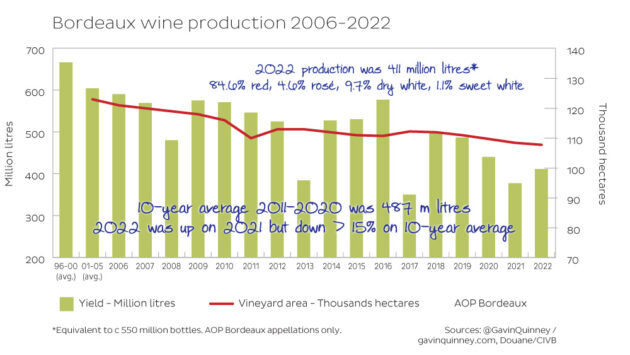
Bordeaux produced 411 million litres of wine in 2022, and although this was more than in 2013, 2017 and 2021, it was a relatively small crop.
At 411 million litres, 2022 was down 15% on the average annual production of 487 ml from 2011 to 2020, and 30% less than the average production of 580 ml from 2001 to 2010. The average from 1996 to 2000 was 666 ml (we came here in 1999).
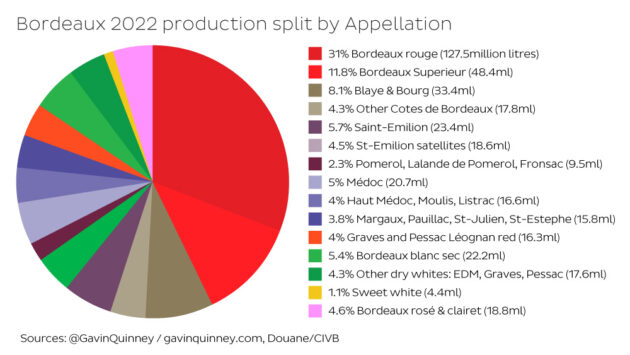
The vast volume of wine comes from the generic Bordeaux appellations. 43% of production is AOC Bordeaux and Bordeaux Supérieur red plus over 12% from the ‘Côtes’ appellations like Bourg, Blaye and others. Saint-Émilion and its satellites clock up over 10% – all red – while dry white makes up less than 10% and, even in a decent year, the sweet whites account for little over 1%.
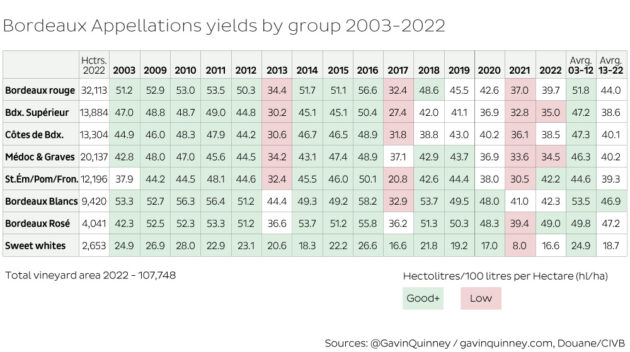
This table above shows the yield per hectare, expressed in hectolitres (100 litres) per hectare. Looking at all the appellations by grouping them together into logical areas, 2022 has been another year of lower yields. For the last two columns on the right, I’ve taken the average yield per year for the 10-year periods from 2003-2012 and 2013-2022. The low production years of 2013, 2017 and 2021, and to a lesser extent 2022, are highlighted in red. The better production years are shown in green.
For the bigger picture in terms of volume, many red appellations have had three comparatively small crops in a row. Most AOP Bordeaux isn’t financially sustainable at under 43hl/ha, nor is Bordeaux Supérieur at less than 37hl/ha.
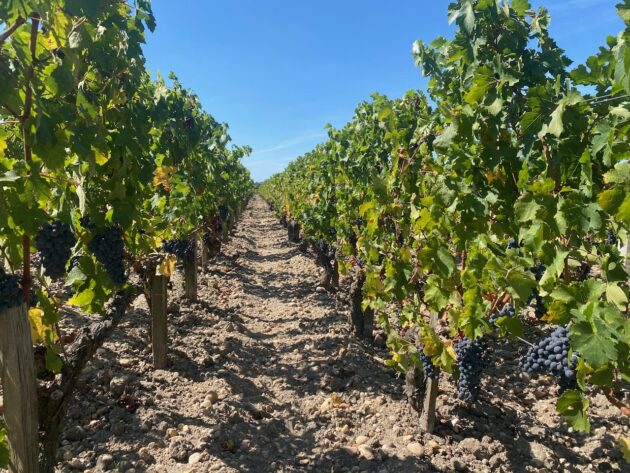
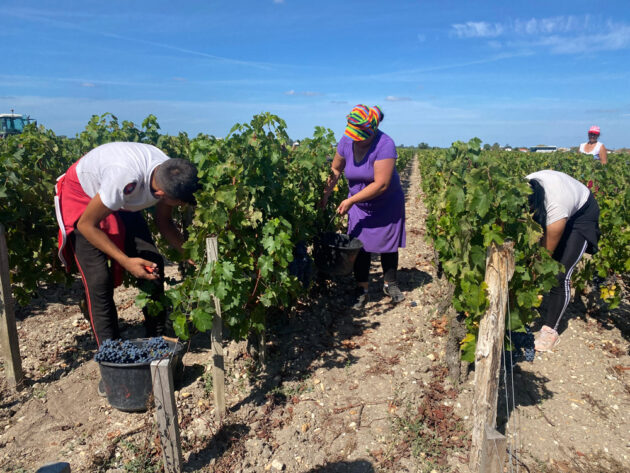
Note also the left bank that the Médoc and Graves combined have seen three lower crops averaging 35hl/ha, compared to over 46hl/ha – a third more – as the average for the decade 2003-2012. (The photo above is of vines in Saint-Julien, 16 September.)
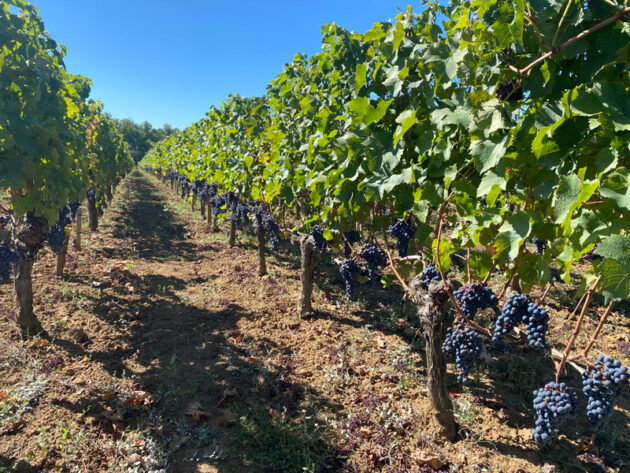
On the right bank in the Libournais areas of St-Émilion (above) and its satellites, Pomerol, Fronsac and so on, they did markedly better in 2022 than some of their ‘rivals’ with over 42hl/ha across the board there. That was probably nature making up for the late-spring-frost-impacted yields there of under 21hl/ha in 2017. See the map below for a breakdown.
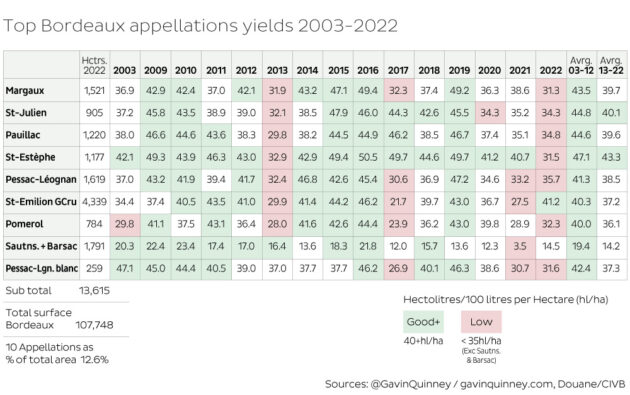
Now for the more prestigious appellations as a group. The vast majority of the top estates that sell their wine as ‘futures’ – or en primeur, some time before bottling – come from these places. (There are a few Haut-Médocs and Côtes wines that you could throw in too.) The last two rows are for white wines, the rest red. By no means all the wine from these appellations is sold en primeur, especially in a large area like Saint-Émilion Grand Cru, but it’s an indication that the ‘famous’ wines represent just a fraction of the total region of Bordeaux.
It’s clear from this table that many of the famous appellations had lower yields in 2022 – notably Margaux, St-Estèphe, St-Julien, Pauillac (the four celebrated areas of the Haut-Médoc) and Pomerol. Yields were more generous in Saint-Émilion, which was the opposite of, say, 2017.
In short, smaller berries in 2022 due to the drought and the heat were behind this, on the whole, and fewer bunches in some areas.
Many of the leading estates in these areas had lower yields – umpteen vineyard directors told me they had yields in the 20s and low 30s (hl/ha) from St-Estèphe down to Margaux and across to Pomerol. The contrast came from some of the leading estates on the clay and limestone terroirs around the village of Saint-Émilion, where they had yields in the 40s and up to 50hl/ha.
And now for the geekiest map for wine nerds, and for all those with a vested interest.
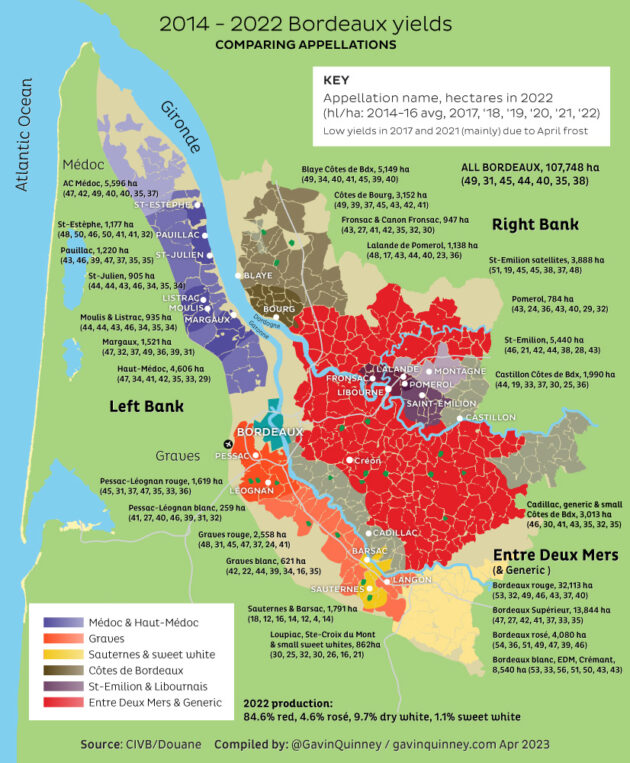
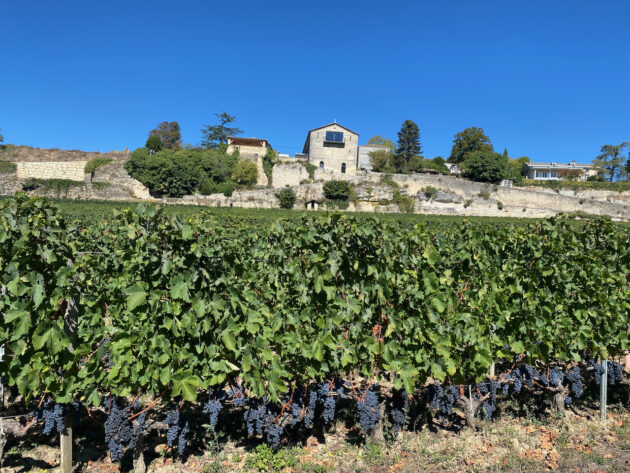
It’s a deep-dive into the yields produced in the different appellations across Bordeaux over recent years. For 2022 there were mixed fortunes, so while some parts of the ‘right bank’, like Saint-Émilion (pictured below), enjoyed more positive returns as I said, others – namely on the ‘left bank’ to the north of Bordeaux – saw lower yields.
Contrast these with 2017, the year of the late April frost when large areas of the Right Bank lost much of the crop, while the premium Haut-Médoc appellations next to the Gironde estuary were unscathed.
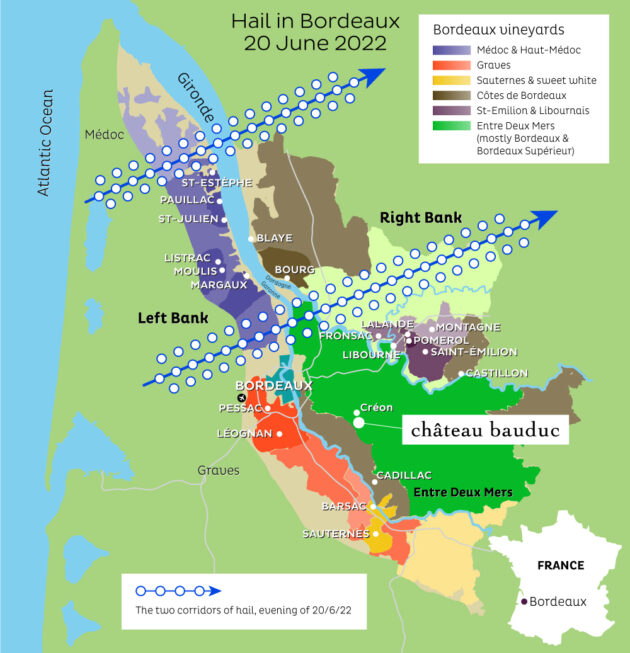
Not forgetting also the losses to hail in late June – see my hail trail photo-journal at the time and my recent Bordeaux 2022 weather report. You can see in the map above that the Haut-Médoc on the left bank and Fronsac on the right had lower yields of 29hl/ha and 30hl respectively, partly due to losses in those areas to the hail.