Tag Archives: Weather

2020 Sauvignon Blanc harvest at Bauduc, in pictures

This was our 2020 Sauvignon Blanc harvest. There’s quite a stream of images to scroll through, and this cuts an even longer story short. Once the grapes are in you can easily forget what happened, so it’s part blog – remember those? – and part aide-mémoire.

Keep reading

Late spring frosts and the luck of the draw

Damaged vines from early May frost, Montagne Saint Emilion 17 May 2019.

Late spring frosts in May are extremely rare in Bordeaux but there were some icy mornings on the weekend of the 5th to 7th May. Some friends here lost the crop from a parcel or two of vines, and although the damage was bad in some spots it was not nearly as widespread as the devastating frost at the end of April 2017. We were spared, fortunately. Keep reading

The same vines pictured year on year in May

22 May 2019

We’ve taken a picture of the Merlot vines in front of the Château on the 23rd May each year. This one was taken on the 22nd because it was so grey and rainy the following day, but it shows how it compares to previous years. (23 May pic below.)

The odd thing is how some vintages are completely different to others. The early budding and growing season of 2011, compared to the late one of 2013, and the hail damaged crop of 2009. Touch wood, so far so good for 2019.

Ten days after a hailstorm at Ch Bauduc on 23 May 2009

The earliest growing season – a burst out of the blocks, 23 May 2011

Keep reading

Bordeaux 2018 weather and harvest report

This report was also published on JancisRobinson.com and on Liv-ex.

Bordeaux 2018 will be remembered as an exceptional year, with no shortage of outstanding wines from this extraordinary vintage. The weather too has been exceptional, with a glorious summer extending long into the September and early October harvest, but the vintage had begun with a bizarrely challenging first half of the growing season. It has ended up, not for the first time, as a year of mixed fortunes.

I’ll try to explain the impact of the weather on yields and quality using – as ever in these vintage reports – a few graphs and statistics.

A dozen highlights of the out-of-the-ordinary 2018 vintage

  • A wet winter, followed by a seriously soggy spring.
  • The threat of mildew, from spring onwards, was the strongest for decades.
  • Hailstorms in May and July caused damage in some unlucky areas.
  • The flowering in May and June was largely successful.
  • A glorious summer, preceded by just enough rain in late June and early July.
  • To have three complete months of sunny, dry weather from early July through to early October is rare.
  • Optimal harvest conditions, stress free, with no risk of rot.
  • A vintage of great potential, with outstanding reds and some very good whites.
  • Balance will be key as alcohol levels are generally quite high.
  • The fourth very good to excellent vintage in a row for 75% of the leading châteaux.
  • Plentiful yields for most growers but low for those hit by mildew or hail.
  • Overall Bordeaux volumes, at a guess, are close to the 10-year average.

The growing season

Here then is the story of the vintage, using daily statistics that I’ve compiled from six different weather stations around Bordeaux.

The amount of rain can differ considerably from one area to another, and even from one commune to another, but this gives a pretty good impression of how the growing season panned out. For a comparison of 2018 with the last two vintages – and they are quite different – see the appendix below.

‘A game of two halves’

At the end of July – the month in which France won the football World Cup – I wrote that Bordeaux 2018 was ‘a game of two halves’. I have to admit I was taking a punt on the weather staying fine for August and September and even, as it happened, for early October, yet it’s extraordinary how the weather stayed so sunny and dry after such a wet start.

The stark contrast in the amount of rain for the period from March to June, compared to July, August and September, and how this compares to other vintages, can also be seen in this grid showing rainfall each month over the last ten vintages.

Keep reading

Véraison – 16 grape varieties changing colour

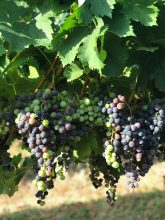
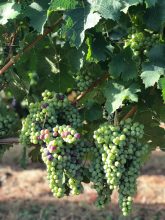
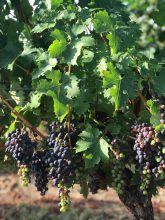
Every stage of the grapes’ development is fascinating to some of us but August is the month when most of the bunches change colour (véraison) in Bordeaux, so you really get a visual perspective on how the different varieties perform.

As well as the Bordeaux varieties, we have some non-Bordeaux grapes too, planted around ten years ago as an experiment. Most visitors have little idea that we’re restricted to growing only certain types of grapes, but that’s the same for all protected ‘appellations’ in France: should we wish to make wine with non-Bordeaux grapes, like Syrah or Chardonnay, this would have to be under the basic Vin de France label. (Only a tiny fraction of wine from the Gironde is Vin de France, the rest ‘Bordeaux’ or one of its 60-odd appellations.)

This is a long post below with several photos of each variety, and you certainly don’t need to know all about this stuff to enjoy a glass or two of wine. However, to give you a picture of how different grapes ripen at different times, here are several reds in the same block, taken on the same mid-August day:


Keep reading

Hail nets get the nod

The INAO, the body that controls viticulture and wine production in the protected Appellations of France, have given approval for the use of anti-hail nets following some extensive tests in Burgundy. Until now, growers in Appellation Contrôlée vineyards have not been allowed to install nets against hail because the effect on the grapes and on the vines hasn’t been properly understood and they can alter the nature of the terroir. Or something like that.

In the big picture of things, this may not seem to be especially significant news but it’s an interesting development for us and for any wine growers who have to live through the fairly regular stress of hail storm alerts. And, from time to time, the real losses from hail damage.

The successful Burgundy tests have taken three years and this coincides with the experimental nets that we installed at Bauduc in June 2015 (above). Our trials were not so much to see if they work against hail (we think they would, though mercifully they’ve not been put to the test) but to assess how long they might last, and what impact there is on the vines, the labour, and the grapes. Now that we’ve been given the feu vert, in effect, we will spend more time and effort really understanding how the grapes behind the nets perform and how they taste during this harvest, compared to the neighbouring rows. Keep reading

Bordeaux 2018 – a game of two halves

This post also appears on JancisRobinson.com and on Liv-ex, the fine wine market website.

I’ll keep the football analogies to a minimum but the end of the month in which France won the World Cup seems an appropriate moment to reflect on the pluses and minuses of the season so far. For wine growers, or viticulteurs, the business end of the season will soon be upon us.

Following on from a wet winter and a thoroughly damp spring, the start of the summer has been dry and hot. In fact, of the last 44 days, 22 have seen temperatures over 30°C around Bordeaux, with another 14 days over 28°C. July itself has been the third hottest in France since 1947, still behind 2006 and 1983 but knocking 2015 into fourth spot. Keep reading

Why the Bordeaux 2017 ‘en primeur’ campaign bombed

Now that all the leading Châteaux have released the opening prices, the 2017 en primeur campaign is all but done. Disappointingly though, the year of the frost has ended up as ‘a damp squib’.

There are many good to very good wines at the top end, but a sub-premium vintage won’t sell at premium prices. The châteaux can charge whatever they like, of course, and no one is forced to buy (as far as I know). I agree though with the many UK merchants who reckon that the prices should be viewed alongside the 2014 vintage, as I said last month.

I’d also rather have 3 bottles of 2016 than 4 bottles of 2017 at this level, in most cases. My tables below, showing my en primeur scores for the leading wines from 2017, 2016 and 2014 and the opening and current market prices for each vintage, demonstrate, wine by wine, why the 2017s have failed to sell. Keep reading

Same vines in late May, different years

Ten days after a hailstorm at Ch Bauduc on 23 May 2009.

Every year on the 23rd May, I take a photo of the Merlot vines outside the château and each picture tells a story. From the hailstorm in May in 2009, to the early harvest in 2011 and 2017, the grotty start to the growing season in 2013 and the normal, good years like 2016. Here are some of those photos.

The earliest growing season – a burst out of the blocks, 23 May 2011.

Keep reading

Bordeaux 2017 – harvest and weather report

The 2017 harvest in St-Emilion

Bordeaux 2017 will go down as the year of the frost. But now that the harvest is complete, it’s clear that this really is a vintage of haves, have-nots and somewhere-in-betweens. For those growers and châteaux with vineyards that weren’t hit, there has been every chance of making very good wine. Here is a look at how the weather stamped an indelible mark on the vintage, along with numerous images of the harvest.

Contents and highlights

Introduction – a small crop
45% down on last year due to April frost (update Feb 2018: 40% down on 2016)
The growing season
Pretty good – rain end of June, dry summer, hot August, damp start to September, fine finish
The harvest – a view from the top
80% of top wines from 150 leading châteaux not impacted by frost
The harvest – Left Bank
A good year for Pauillac, St-Julien, St-Estèphe
The harvest – Right Bank
A year of contrasts, in photos
The harvest – AC Bordeaux appellations
Mixed bag, an early harvest
Opinion – ‘très hétérogène’
A good, bad and ugly year
Opinion – a note on prices
Bulk prices up, not so for top wines
The en primeur tastings
Second not first week of April 2018

Appendix
The weather charts
Comparisons with previous years
Frost map of Bordeaux 2017


Introduction – a small crop Keep reading