


Is 2020 another top Bordeaux vintage and what are the chances of a strong ‘en primeur’ campaign after the success of the 2019s?
(A shorter version of this post forms the basis of my article on the primeurs for Harpers Wine & Spirit, June issue. I’ll be updating the recommended wines below as I continue to taste at the leading châteaux.)
A little over a year ago I was speaking to Ronan Laborde, the new President of the Union des Grands Crus de Bordeaux. Would the top châteaux still try to sell their new vintage a year before it was bottled, when all the tastings had been put on hold and the world was in lockdown? Why the rush when the wines have another 12 months in barrel, and was it the right thing to do during a pandemic?
‘Gavin,’ he replied, ‘it is in the DNA of the grands crus of Bordeaux to sell en primeur.’ And that was that, really. I duly received my invitation for a properly distanced press tasting of 2019 barrel samples from the UGCB – an association of 131 leading estates – at the Grand Hotel in the city for the first week of June. A week before that event, Château Pontet Canet announced that their price for the 2019 was 31% less than for the 2018. The 2016 had been released at €108 per bottle, ex-Bordeaux negociant, and the 2018 at €84. The 2019 – an excellent vintage as far as I could tell – was to be €58. Game on.
Many of the 2019s at that tasting were superb, and when the prices came out – conveniently, all within a few weeks of each other – I ended up buying a couple of cases each from a dozen UGCB châteaux, for ‘personal’ consumption. (I’ve listed these at the foot of the page*.) I haven’t done that for years, and I wasn’t alone in coming back to ‘en primeur’. For the campaign as a whole, prices for the 2019s were 21% lower on average than 2018, according to Liv-ex.

So, can the 2020s pull off the same trick and how do they stack up?
Let’s start with the wines. There’s little doubt that 2020 completes a fine tryptych of 2018, 2019 and 2020 and, along with 2016, that’s four out of five superb vintages.
At a similar tasting at the UGC in the Grand Hotel in Bordeaux I found many excellent samples, if not the instant thrill of discovering something truly exciting. The charm of the 2019 vintage was, I think, immediately obvious whereas the 2020s require more reflection and selection. There are some brilliant wines and – though it’s all too easy to say this – it is not a consistent ‘a-rising-tide-lifts-all-boats’ type vintage.

The initial impression from the UGC and other tastings – both at individual châteaux and at group events – is that 2020 was particularly successful on the right bank in the better parts of Saint-Emilion, Pomerol and Fronsac and, on the left bank, in Pessac-Léognan and in Saint-Estèphe. (There’s a lot of clay in Saint-Estèphe which helped retain some much needed moisture through the summer and September drought.)
In Margaux, Pauillac, Saint-Julien and the Haut-Médoc generally, there are several stars from the great terroirs (think blue chip names) but more than a few wines were attractive, classic and ‘correct’ – but lacked something in the middle palate. I do think though that many will put on weight and perhaps an added dimension during the all-important élevage (the ageing in barrel, like at Troplong Mondot, above).
The dry whites were very good and the Sauternes and Barsacs attractive but only a few that showed really moreish botrytis character.
Wines to buy if the price is right
(I love Lafite Rothschild 2020, but…)
Saint-Estèphe
Calon Segur, Montrose, Cos d’Estournel (£££)
(Value picks – Lafon Rochet, La Dame de Montrose, Marquis de Calon, Capbern, Meyney, de Pez)
Pauillac
Pichon Lalande, Pichon Baron, Pontet Canet, Grand Puy Lacoste, Lynch Bages
(Value picks – Les Griffons de Pichon – which is to be offered EP for the first time this year, Batailley, Haut Batailley)
Saint-Julien
Léoville Barton (I’ll be tasting Ducru Beaucaillou and Léoville Las Cases soon.)
Margaux
Rauzan Segla, d’Issan, Giscours. (I’ll be tasting Palmer 2 June.)
(Value picks – Kirwan and, next door in Haut-Médoc, La Lagune)
Pessac-Léognan
Domaine de Chevalier, Pape Clement, (I’ll be tasting Haut-Bailly 1 June.)
(Value picks – Olivier, Brown)
Saint-Emilion
Canon, Canon la Gaffeliere, La Gaffeliere, Troplong Mondot, Pavie Macquin
(Value picks – La Tour Figeac, Fonroque, Grand Corbin Despagne, Villemaurine)
Pomerol
L’Evangile, Clinet, Feytit Clinet (a non-exhaustive list)
(Value picks – Croix de Gay, Rouget, La Pointe)
Tastings, scores, notes and prices
The world of fine wine used to descend on Bordeaux each Spring to sample the new vintage, and now Bordeaux sends out the samples to the world.
Many of the leading chateaux have adopted their own processes for sending out wines in various formats to merchants and wine writers, and the associations likewise.
Ronan Laborde told me that 310 tasting sessions of the 2020s were set up by the UGCB to reach round 2,500 wine professionals worldwide (100 wine journalists and 2,400 wine merchants). 220 of these were with his UGCB staff and their agencies in Bordeaux, Paris, Brussels, Shanghai and Hong-Kong, and 90 were for wine journalists and merchants in the US, UK, Canada, Germany and Switzerland.
So now there is no shortage of tasting notes from critics and wine merchants alike. In a way that’s great that the trade and the press have prepared a ton of material for a well-oiled sales campaign. (It’s a strange, symbiotic relationship between Bordeaux châteaux, their distributors and the journalists.)
My worry is that the en primeur campaign has followed the same path for years – the châteaux wait to see what the critics say and then price their wines according to the (often positive) critical acclaim. Consumers then turn their noses up at over-inflated prices. En primeur had been in the doldrums for years – despite several excellent vintages – until the refreshingly different 2019 vintage: great wines at a fair price. It’s not that complicated.
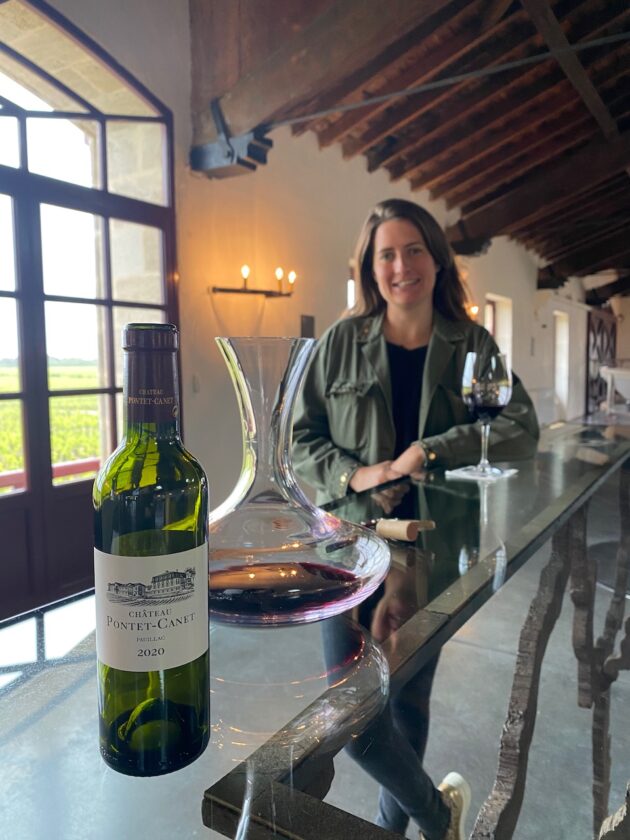
Justine Tesseron at Pontet Canet, Pauillac 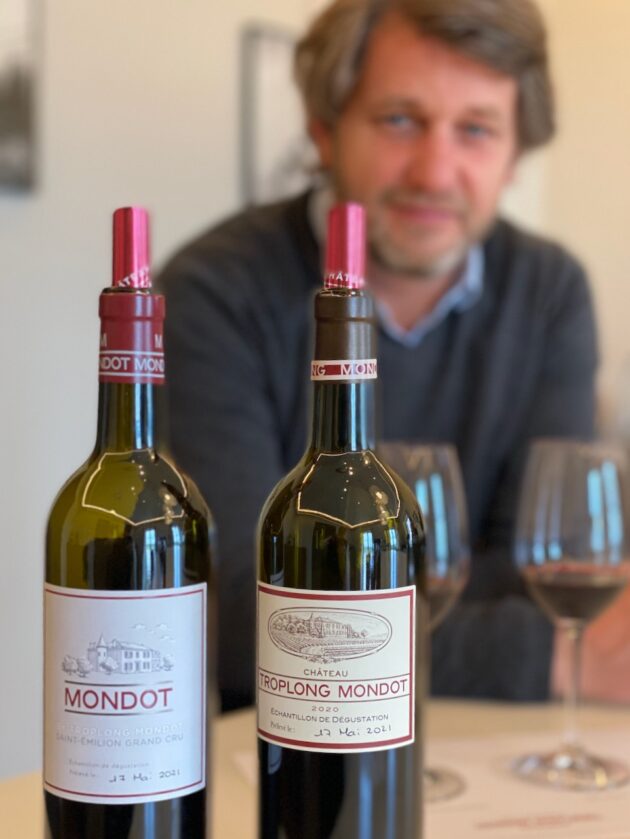
Aymeric de Gironde at Troplong Mondot, St-Emilion
For this campaign, the prices need to be right and consumers need to be told why a wine is worth buying – value wise – and not just because of some favourable tasting note comprising lashings of ripe fruit cascading across the tongue, cashmere tannins, 93-95 points, and so on.
Justin Gibbs, co-founder and director of Liv-ex, gave me his sensible view on prices. ‘The feeling seems to be that a headline increase of more than 10% over the highly regarded 2019 vintage makes a sales more challenging. This said, the year on year change is less relevant than how the price looks against physical vintages of similar quality, so each release will need to be judged on its own merits. Scores and reports suggest this is a very good vintage, better in some parts than 2019 and 2018, but not a homogenous vintage like 2016. Reports suggest that the enthusiasm for this year’s campaign may not be quite as electric as last year – it is important therefore for release prices to leave something for the market.’
Smaller volumes
I’ve mentioned about yields for the top red appellations being well down on 2019 below. At the individual estate level, there will be some awkward conversations to be had regarding allocations of stock sold en primeur, even without taking the pricing into account.
Saint-Estèphe, for example, was one appellation in the Haut-Médoc that didn’t fare too badly, being the only one with a general yield over 40hl/ha at 41.2hl/ha. The variation from one estate to another was, however, quite pronounced: Château Montrose at 29hl/ha, Calon Ségur at 33hl/ha, Cos d’Estournel at 39hl/ha, Phelan Ségur at 42hl/ha and Meyney at 45hl/ha. And there’s the selection process, with 45% of the crop at Montrose going into the Grand Vin, 47% at Calon and so on. Over the road in Pauillac, Lynch Bages at 34hl/ha and Lafite at 36hl/ha, with Pontet Canet somewhere in between.
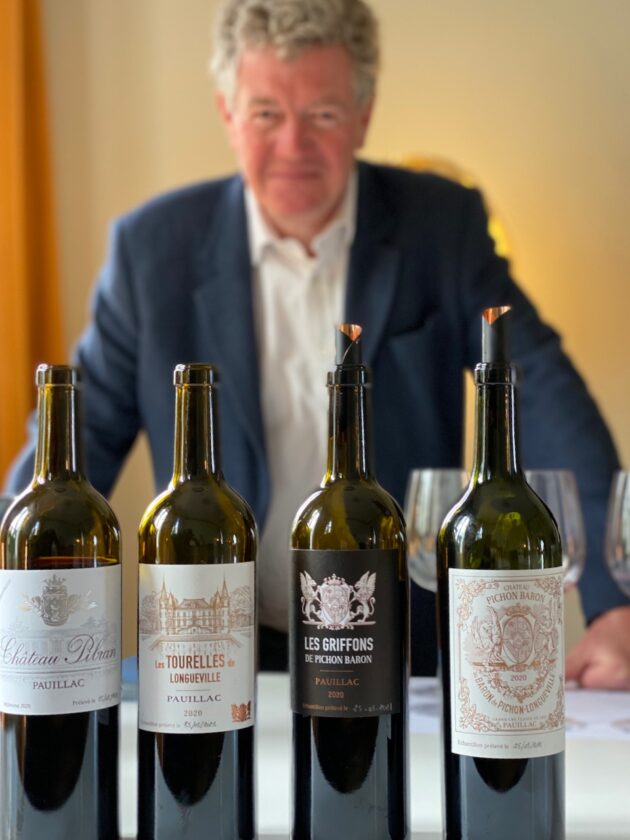
Christian Seely at Pichon Baron, Pauillac 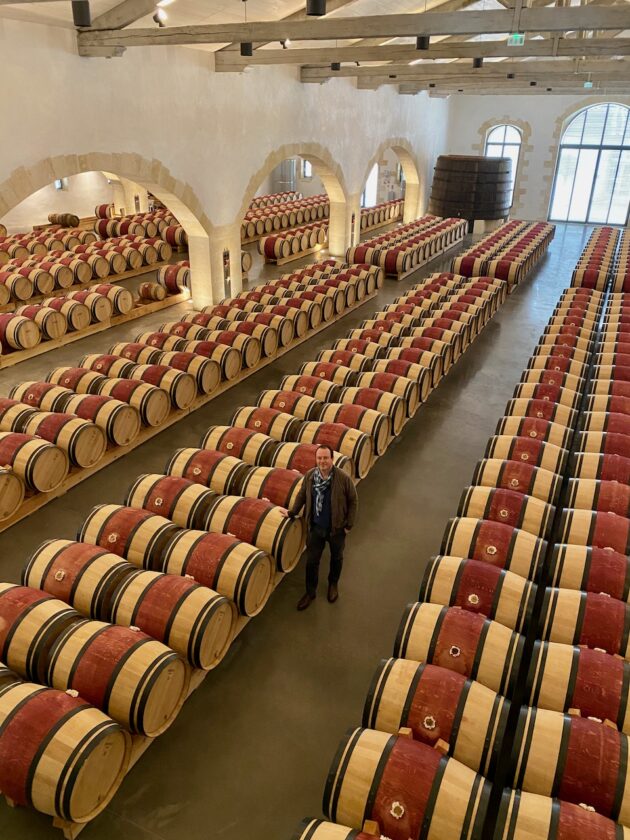
Vincent Millet at Calon Ségur, St-Estèphe
As Christian Seely at Pichon Baron says, consumers aren’t concerned about how much wine a particular estate makes in any given year (apart from me, that is). But I can well imagine that Vincent Millet may have some worries when he’s got just 80,000 bottles of Calon Ségur for his 850 distributors across the world, via his network of Bordeaux negociants. Still, there are worse problems in life.
Appendix – some production and weather stats
These graphics started life in my Bordeaux 2020 weather and harvest report from last October – more details there – and my production analysis on 2020 Bordeaux yields from this February.
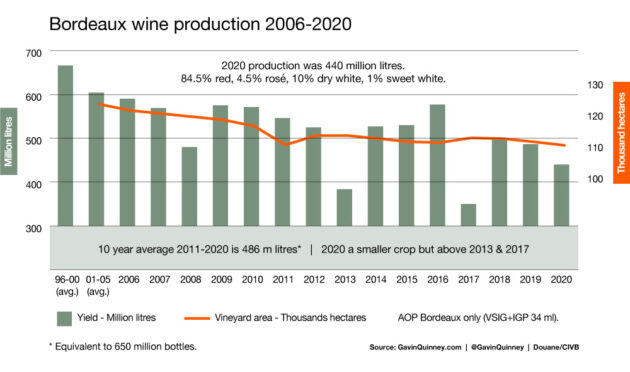
Production across Bordeaux in 2020 was 10% down on the 10-year average and on 2019, though yields were even lower in the more prestigious areas. Eight of the best known are shown, with their highs and lows over recent years.

For the most prominent red appellations in the en primeur game, the amount of wine made was significantly less than in 2019. St-Julien, Margaux and Pessac-Léognan were 25-27% down on the previous year, Pauillac 20%, Saint-Estephe 17% and Saint-Emilion Grand Cru 15%.
Like 2018, yields vary considerably from one estate to another.
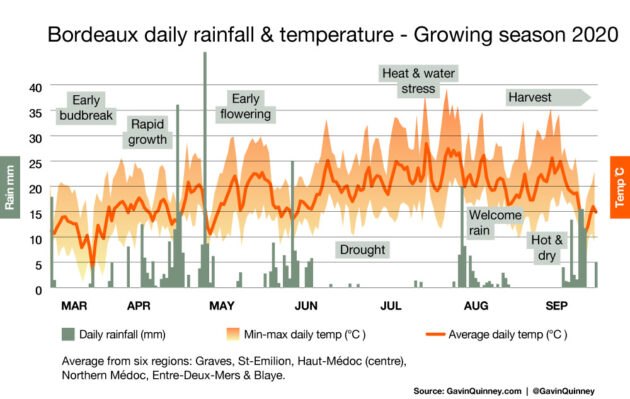
The growing season in 2020 followed a similar pattern to 2016, 2018 and 2019, in that Bordeaux had a wet spring followed by a dry, hot summer, topped off by a warm, dry harvest. Note the monthly rainfall from March through June, compared to July and August.
Unlike 2016 and 2019, it was an early vintage – not unlike 2018, timing wise. It is still uncommon for almost all the red grapes to be harvested in September, as was the case in 2020, as the cabernets are normally picked well into October.
The paradox is that the better wines don’t taste as if they’re from a hot or parched vintage, as they have vivacity, freshness and balance.
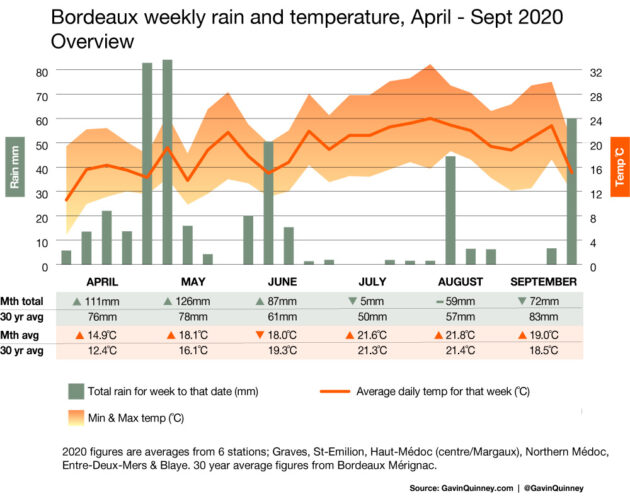
After a rainy spring, 54 days of drought gripped Bordeaux from mid-June, then 20 more dry days after the last weekend of August.
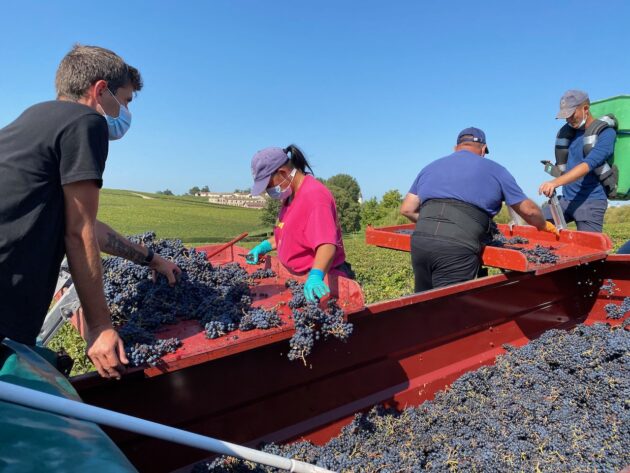
The harvest began in late August for dry whites and the cool nights and clear days were ideal for the ripening of the reds in the first half of September. Some Merlots came in earlier in the precocious vineyards, like Pomerol, but the red harvest really kicked off from the week of 14 September, and was all but over within two and a half weeks. The Cabernet Sauvignon was mostly harvested from 21 September onwards.
Mid-September was marked by hot days in the low to mid 30s, which potentially reduced the amount of juice, and the weather turned somewhat from the 20th, with rain at the end of that week. There was, however, a final harvest window of three clear days from Monday 28th.
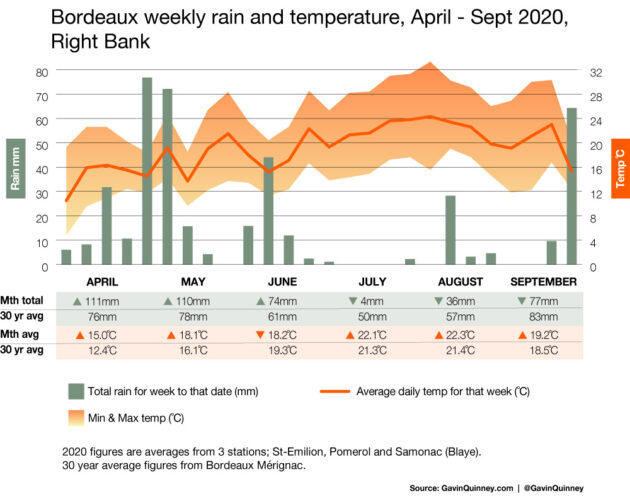
Many commentators will note that 2020 is a year in which the right bank excelled. With every vintage, it can be useful to understand the regional variations in the weather and 2020 is no exception. Much less rain fell in August on the right bank than on the left bank – north of Bordeaux, in the Médoc.
As Merlot – the mainstay of Saint Emilion and Pomerol – generally ripens before the Cabernets, there’s a noticeable difference with subsoils like clay and limestone that provide the vines with just enough sustenance, compared to drier terroirs.
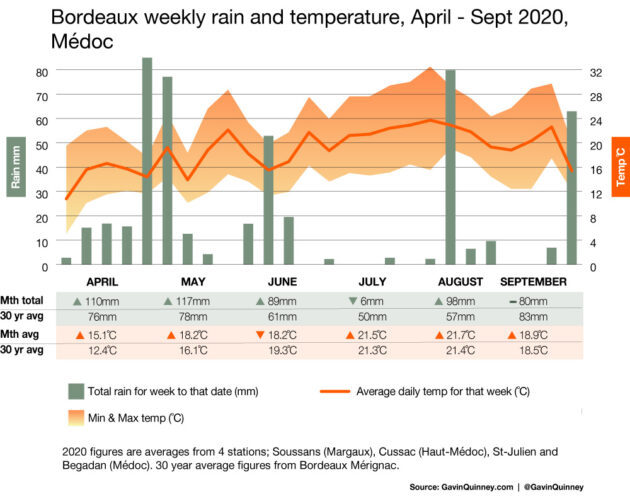
The August rains were welcome too for the later ripening Cabernet Sauvignon in the Médoc.
More on 2019 en primeur
* 2019s from the UGCB that I bought:
Château Saint-Pierre 2019
Saint-Julien
Château Langoa-Barton 2019
Saint-Julien
Château Branaire Ducru 2019
Saint-Julien
Château Batailley 2019
Pauillac
Château Giscours 2019
Margaux
Château Lafon-Rochet 2019
Saint-Estephe
Château Phélan-Ségur 2019
Saint-Estephe
Château Malartic-Lagravière rouge 2019
Pessac-Léognan
Domaine de Chevalier rouge 2019
Pessac-Léognan
Château Rouget 2019
Pomerol
Château La Gaffeliere 2019
1er GCC, Saint-Emilion
Château Latour-Martillac blanc 2019
Pessac-Léognan
I thought these two graphs from Thomas Parker MW of Farr Vintners were pretty revealing, in a video seminar from the Masters of Wine which reviewed the Bordeaux 2019 en primeur campaign. (Look for ‘Perceptions of Bordeaux en primeur.’
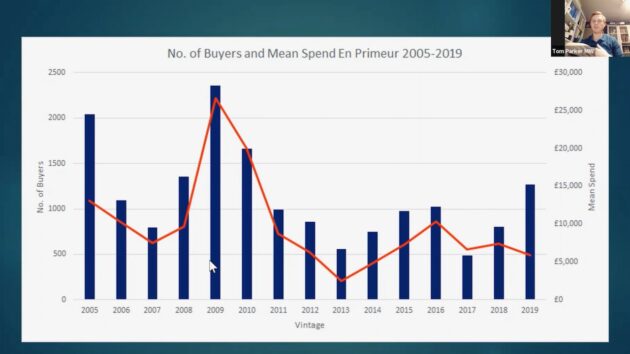
Thomas is the highly respected buyer for Farr, one of the biggest – if not the biggest – buyers of Bordeaux en primeur in the UK. Essentially there were more individual buyers for 2019 than for any other vintage in the last decade.
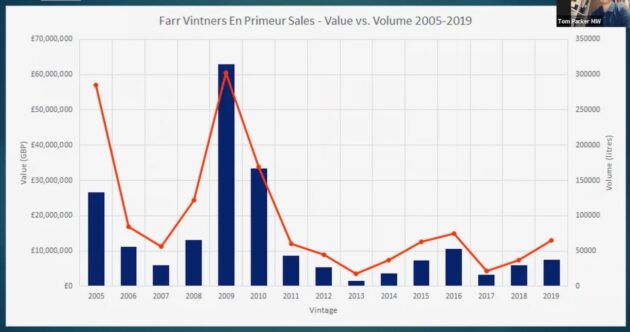
When you consider that 2019 and 2016 are along the same lines, quality wise, as 2005, 2009 and 2010, Bordeaux should be doing better en primeur. But at least there was a lift for the 2019s – in pretty difficult circumstances.