

The top wines from Bordeaux 2022 are sold ‘en primeur’ by merchants during May and June, as soon as they are released by the châteaux and on through the Bordeaux trade. I wrote two articles on Bordeaux 2022 for the UK trade magazine, Harpers Wine & Spirit, for the April and May issues. The first was on how the weather shaped the vintage, the second on the wines themselves, along with some production stats.
For my other published reports on Bordeaux 2022, see Bordeaux 2022 weather and harvest report and Bordeaux 2022 – lower yields to mean higher prices?
The Harpers articles are probably easiest to view by downloading the two pdfs below, though the text is underneath if you need it:

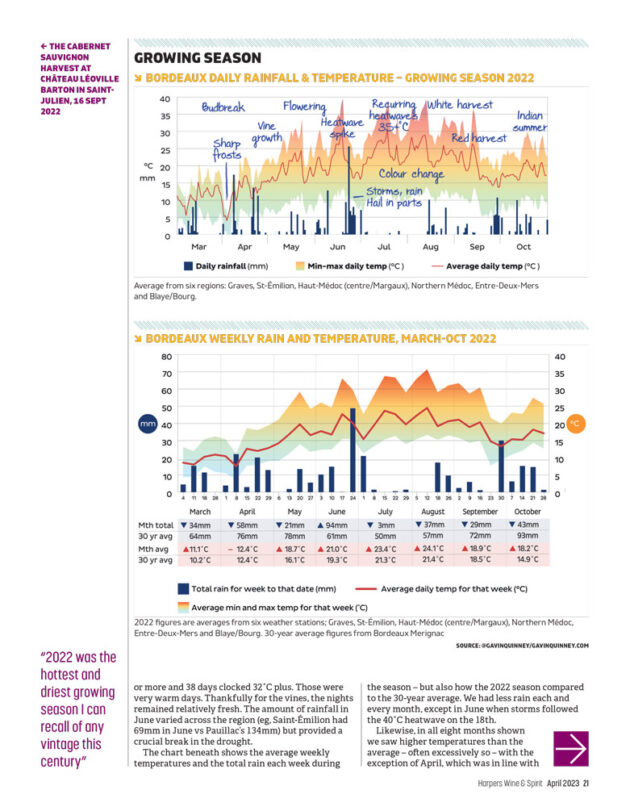
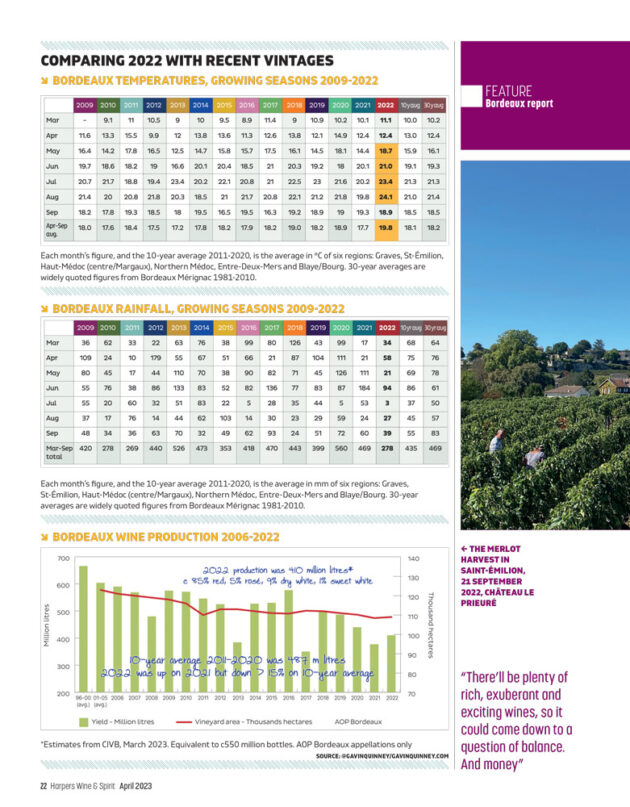
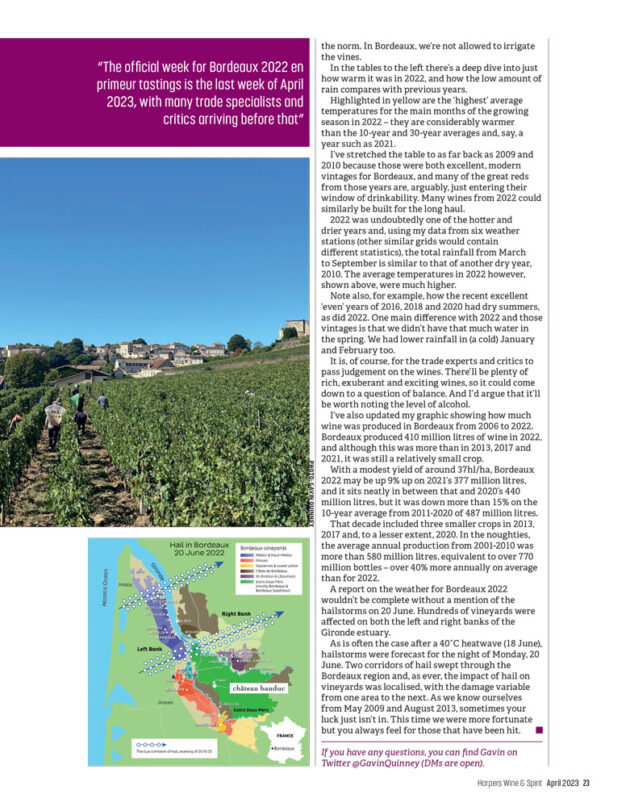

The weather factor – Bordeaux 2022 (April issue)
Bordeaux 2022 was a remarkable year. In short, it was both hot and dry during the growing season in 2022, with long periods of drought and protracted summer heatwaves. It really was a year of highs and lows – namely high temperatures and low rainfall.
What was also remarkable was that the vines, not least in the better-placed vineyards, held up incredibly well.
I’ve been putting together these reports for more than 20 years, having worked and lived through each vintage, and they serve as a backdrop as to why the wines taste the way they do – even at this early stage. They also help put 2022 into context with recent vintages: it was the hottest that I can recall, and that includes the steamy 2003.
The white harvest began early in mid-August and the vast majority of the red grapes for Bordeaux 2022 were harvested in September, much like in 2018 and 2020. (In many other great years, such as in 2010, 2016 and 2019, the red harvest stretches well into October.)
The first chart shows broadly what happened in the vines at each stage. In the 20 weeks from 7 May to 23 September, 117/140 days saw daytime temperatures reach 24˚C or more, 72 registered 28˚C or more and 38 days clocked 32˚C plus. Those were very warm days. Thankfully for the vines, the nights remained relatively fresh. The amount of rainfall in June varied across the region (eg Saint-Émilion had 69mm in June v Pauillac’s 134mm) but provided a crucial break in the drought.
The chart underneath shows the average weekly temperatures, and the total rain each week, during the season – but also how the 2022 season compared to the 30-year average. We had less rain each and every month, except in June when storms followed the 40˚C heatwave on 18th June. Likewise, in all 8 months shown we saw higher temperatures than the average – and often excessively so – with the exception of April which was in line with the norm. In Bordeaux, we’re not allowed to irrigate the vines.
In the tables opposite there’s a deep dive into just how warm it was in 2022, and how the low amount of rain compares with previous years.
Highlighted in yellow are the ‘highest’ average temperatures for the main months of the growing season in 2022, and they are considerably warmer than the 10-year and 30-year averages and, say, a year like 2021.
I’ve stretched the table to as far back as 2009 and 2010 because those were both excellent, modern vintages for Bordeaux, and many of the great reds from those years are, arguably, just entering their window of drinkability. Many wines from 2022 could similarly be built for the long haul.
2022 was undoubtedly one of the hotter and drier years and, using my data from six weather stations (other similar grids would contain different statistics), the total rainfall from March to September is similar to that of another dry year, 2010. The average temperatures in 2022 however, shown above, were much higher.
Note also, for example, how the recent excellent ‘even’ years of 2016, 2018 and 2020 had dry summers, as did 2022. One main difference with 2022 and those vintages is that we didn’t have that much water in the spring. We had lower rainfall in (a cold) January and February too.
It is, of course, for the trade experts and critics to pass judgement on the wines. There’ll be plenty of rich, exuberant and exciting wines, so it could come down to a question of balance. And, I’d argue, that it’ll be worth noting the level of alcohol.
I’ve also updated my graphic showing how much wine was produced in Bordeaux from 2006 to 2022. Bordeaux produced 410 million litres of wine in 2022, and although this was more than in 2013, 2017 and 2021, it was a relatively small crop.
With a modest yield of around 37hl/ha, Bordeaux 2022 may be up 9% up on 2021’s 377 million litres, and it sits neatly in between that and 2020’s 440 million litres, but it was down more than 15% on the 10-year average from 2011-2020 of 487m litres.
That ’11-’20 decade included three smaller crops in 2013, 2017 and, to a lesser extent, 2020. In the noughties, the average annual production from 2001-2010 was over 580 million litres, equivalent to over 770 million bottles – over 40% more annually on average than for 2022.
A report on the weather for Bordeaux 2022 wouldn’t be complete without a mention of the hailstorms on 20 June. Hundreds of vineyards were affected on both the left and right banks of the Gironde estuary.
As is often the case after a 40˚C heatwave (18 June), hailstorms were forecast for the night of Monday, 20 June. Two corridors of hail swept through the Bordeaux region and, as ever, the impact of hail on vineyards was localised, with the damage variable from one area to the next. As we know ourselves from May 2009 and August 2013, sometimes your luck just isn’t in. This time we were more fortunate but you always feel for those that have been hit.
If you have any questions, you can find me on Twitter @GavinQuinney (my DMs are open).
Some like it hot – Bordeaux 2022 (May issue)
2022 was a remarkable year in Bordeaux, and the en primeur tastings in April for the trade and the press confirmed that. The jury may be out on just how brilliant the wines are, but if 2022 is indeed a great vintage then it would be the first ‘vintage of the century’ that was marked by such extreme heat and drought, fairly uneven quality and low yields in all the top red appellations, with the exception of Saint-Émilion.
Some châteaux have produced wines that may rival or even surpass their efforts from the superstar years of 2009, 2010, 2016 and, say, 2019. They also share some of the characteristics of the successful, sunny triumvirate of ’18, ’19 and ’20. Yet all those were more consistent years for quality, in my opinion.
2022 was an extraordinary year because the growing season was so hot and dry. Taking the data from six weather stations based around the region, we had the warmest versions of May, June, July and August in at least the last 15 years. September was also warmer than average, while April was in line after a frosty start. At times it was also crazily hot, with a series of summer heatwaves on and off from mid-June through to mid-September. Thankfully for the vines, and for us, the August nights remained relatively fresh.
Mercifully we had a wet December in 2021 because every month from January 2022 onwards saw less rain than the average, and much less in the ripening months of July, August and September – except June, when a 40+˚C heatwave mid-month gave way to storms on the 20th. Typical of the unfair nature of viticulture is that while the majority of vineyards were refreshed with much needed rain, others were struck by hail with randomly devastating results.
The impact of a year of high temperatures and low rainfall naturally resulted in wines with high alcohol and low acidity – highs and lows all round. And yet the vineyards, especially the better placed ones, held up incredibly well despite the ongoing drought and heat. So many of the better vineyards looked perfectly healthy well into early autumn. Had the vines adjusted to the drought conditions at an early stage, as many vineyard managers pointed out? (For us, that late June rain helped enormously.)
Almost all the red grapes were picked in September – though there are always exceptions: Cheval Blanc, for starters, began harvesting their merlot in late August and if the wine’s anything to go by, it was a smart move. Some cabernets elsewhere came in as late as October.
So what we see are wines that are indeed layered with ripe fruit, fairly high in alcohol on the whole, yet the best are still refreshing and balanced – often thanks to beautifully mature tannins. Balance, as we call it, is key, though I’d still suggest alcohol levels are included in any tasting notes for potential buyers.
Yields, supply, demand and prices
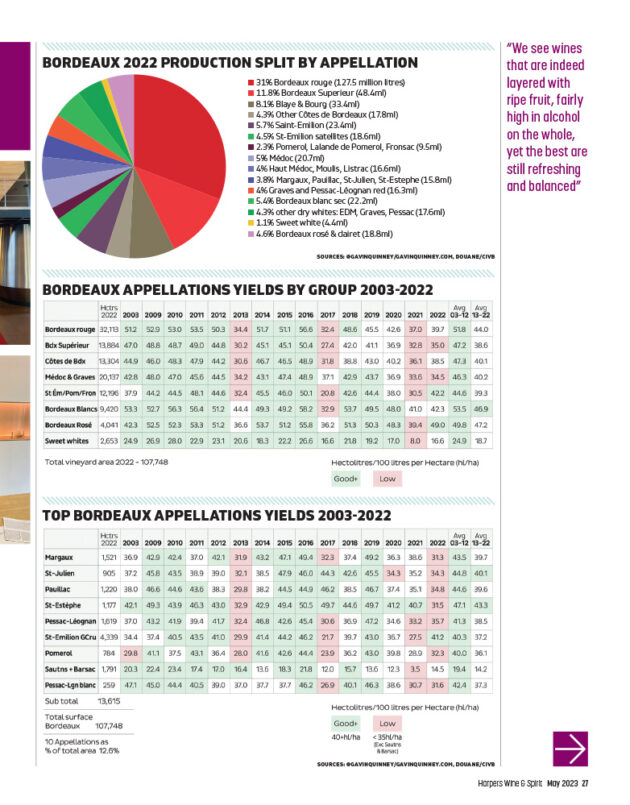
With the tastings over, attention turns to release prices for the top wines. What we’re talking about here are the leading 250-500 wines from the region, not the engine room of generic Bordeaux and so-called lesser appellations. The comparative volumes can be seen in the pie chart, and the yields for Bordeaux overall in the first table.
For the top appellations table, I’ve compared the yields of 2022 with the 10-year averages from 2003-2012 and 2013-2022, on the right. Also shown are the yields going back to the excellent years of 2009 and 2010. These yields are all expressed in hectolitres (100 litres) per hectare and the first eight are red appellations, and the bottom two for white wine. I’ve also added 2003 as many observers are comparing the summer heatwaves in 2022 with 2003.
You can see that the top left bank appellations of Margaux, St-Julien, Pauillac and Saint-Estèphe had considerably lower yields in 2022, mainly due to smaller grapes. Many top estates mentioned yields in the 20s and low 30s hl/ha – and in Pomerol too. With high scores from critics before prices are announced, and demand being high, it seems extremely unlikely that the wines are going to be given away lightly. (That really would make it an extraordinary vintage if I’m wrong.) The main area that saw pretty successful yields was in Saint-Émilion with some of the leading wines on the clay over limestone there seeing yields in the mid-high 40s.
The wines
2022 was a really enjoyable vintage to taste, and not just because of the ripe, dark fruits and well-knit tannins. Having lived and worked through such a hot and dry season the freshness shown in so many of the wines was a happy surprise, and I found most reds were well made with few being – for example – overly extracted. There is a lightness-of-touch being demonstrated in Bordeaux these days and it’s most welcome.
But having witnessed some of the early hype, I was conscious of Matt Kramer quoting Pasteur quoting Bossuet in his book ‘Matt Kramer on Wine’: “The greatest disorder of the mind is to believe that things are so because we wish them to be so.”
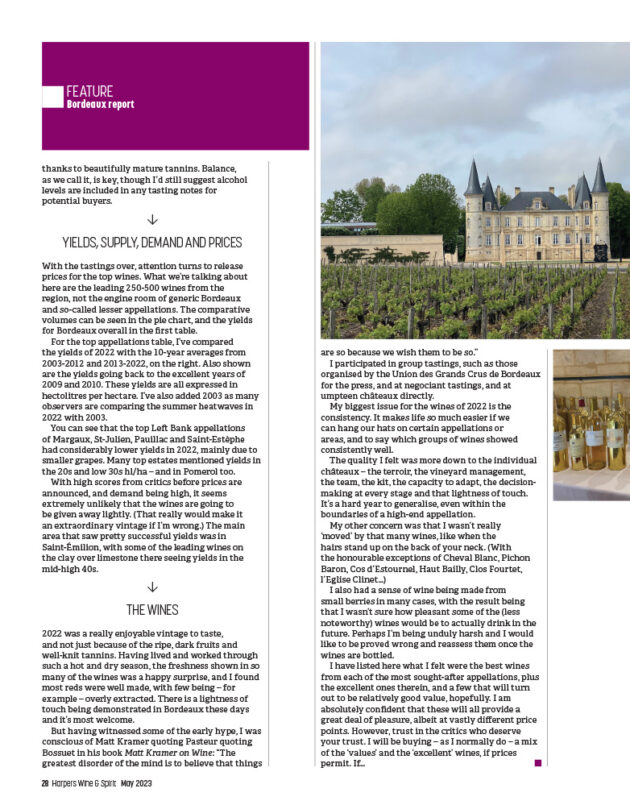
I participated at group tastings, such as those organised by the Union des Grands Crus de Bordeaux for the press, and at negociant tastings, and at umpteen châteaux directly.
My biggest issue for the wines of 2022 is the consistency. It makes life so much easier if we can hang our hats on certain appellations or areas, and to say which groups of wines showed consistently well. The quality I felt was more down to the individual châteaux – the terroir, the vineyard management, the team, the kit, the capacity to adapt, the decision making at every stage and that lightness of touch. It’s a hard year to generalise, even within the boundaries of a high-end appellation.
My other concern was that I wasn’t really ‘moved’ by that many wines, like when the hairs stand up on the back of your neck. (With the honourable exceptions of Cheval Blanc, Pichon Baron, Cos d’Estournel, Haut Bailly, Clos Fourtet, l’Eglise Clinet… .)
I also had a sense of wine being made from small berries in many cases, with the result being that I wasn’t sure how pleasant some of the (less noteworthy) wines would be to actually drink in the future. Perhaps I’m being unduly harsh and I would like to be proved wrong and re-assess them once the wines are bottled.
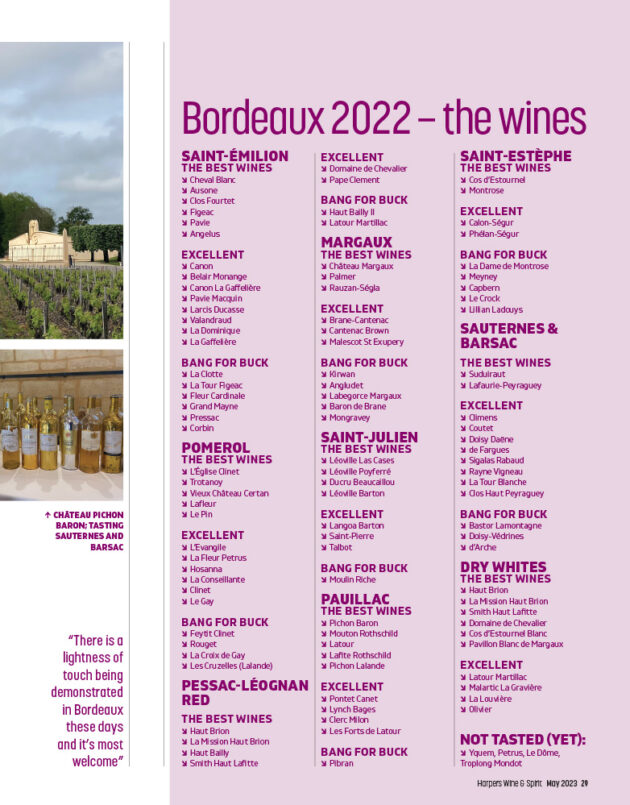
I have listed here what I felt were the best wines from each of the most sought-after appellations, plus the excellent ones therein, and a few that will turn out to be relatively good value, hopefully. I am confident that these will all provide a great deal of pleasure, albeit at vastly different price points. However, trust in the critics who deserve your trust. I will be buying – as I normally do – a mix of the ‘values’ and the ‘excellent’ wines, if prices permit. If…