

La Gazette was posted to UK customers on 24th November. Let us know if you’d like to be included on our mailing list – email gavin at bauduc.com. Here you can view a draft copy online – simply click on the image below to open a new window and flick through La Gazette using some cunning software called flipdocs. Sadly, it doesn’t work on an iPad. Your comments are very welcome:
Category Archives: Chateau Bauduc
2010: a Remarkable Vintage for Bauduc
October 28 2010
We harvested our red grapes in perfect condition during October. Whether other Châteaux in Bordeaux are making wines as good as or even better than last year remains to be seen, but after frost here at Bauduc in April 2008 and hail in May 2009, it’s a welcome change for us to bring in such quality, and quantity.
2010 has been a remarkable year for us in so many ways.
 1. No major natural disasters: no Spring frost to decimate the yield by nipping the shoots in the bud. No late Spring hail to destroy the young shoots and baby bunches. Even the drought conditions this Summer didn’t dry up our hopes for a splendid crop. Let’s pray that there’ll be no repeat of any damaging storms this Winter.
 2. No man-made catestrophes: no tractors catching fire during the harvest (above right, in 2009), and no trailors full of grapes tipping over: our former employee, Sebastien, pictured right, was probably wishing he’d taken a sicky the day I took this shot in late September, 2005. I’ve not published this photo before as it wasn’t exactly our finest hour. We ended up selling the tank of wine that these grapes went into, in ‘bulk’ and at a loss.
How to Steal a Crop from a Vineyard
October 04 2010
I wish I’d thought of that. I don’t mean stealing someone’s else crop for filling up our fermentation tanks (as regulars know, this would have come in handy last year, after we lost 80% of our crop to hail in May). But we certainly missed a trick as potential victims of such a crime. We could have had the children crying in front of the cameras.
 Now I’m quite sure that there is nothing false about vigneron Roland Cavaille’s claim that his Cabernet Sauvignon grapes were swiped at night last week, costing him some €15,000 in lost revenue and a year’s hard labour. The surprise is that the world’s media have got hold of the story with such fruity conspiracy theories. Google his name and you’ll find 50 news stories about the grape heist, including this film from the BBC.
Here’s a ‘Wine Mafia’ report from the London Evening Standard:
“Two harvesting machines were used to take about 35 tonnes of the ripened fruit from a field in the Languedoc-Roussillon region. “These are some of the best grapes in France, and we fear a wine mafia gang has stolen them,” said a detective. He believes the grapes were taken straight to a specialist to create a fine vintage.” Keep reading
Red October: Our 2010 Merlot Harvest
Our red wine harvest at Château Bauduc kicked-off at 6 o’clock in the morning on Friday, 1st October. One 2 hectare (5 acre) block of 12,000 Merlot vines was harvested in tiptop condition, and we were done and dusted by 10.30 am.
 A team of eight manned the sorting table to make sure that no unwanted bits went into the stainless steel fermentation tank. (I say manned but the team was made up of one strapping lad known as The Apprentice, plus seven ladies.) In addition, there was Daniel, Nelly, Ange, me – and Guy on his sexy harvesting machine.
With the dry conditions continuing up to the harvest, there was no rot on the bunches whatsoever, so we were able to pick by machine during the coolest, freshest part of the day. Keep reading
Dry Whites All In, Reds Kick Off
September 28 2010
The Sauvignon Blanc and Sémillon for the dry whites are mostly in – we finished our Sémillon yesterday – and some estates on the Right Bank, in Pomerol and St-Emilion, have picked Merlot from young vines in the last week (such as Château Canon in St-Emilion, below right).  The Merlot harvest started in earnest this week in the Médoc. Hardly a grape had been picked there until now, and they’ll start attacking the Cabernet Sauvignon from next week onwards. If you have the chance to see the harvest in action, on both Banks, sometime over the next fortnight or so is the time to come, although there’s much less to see on the outside at weekends.
The weather leading up to the key picking dates could make the difference between, well, seriously good and great. In case you weren’t aware, we had half as much rain in Bordeaux in the six months to the end of August compared to 2009, which was, of course, a dry year.
 The weather in September has been fine, with a dash of refreshing rain in the second week and last week on Friday, 24th. As luck would have it, a drying northwesterly breeze blew off any humidity in the vines on Saturday, averting the risk of rot. The forecast is fine, just for the moment. We don’t really want to pick for the reds until next week, although we have harvested some Merlot plots early to make some rosé. This year, just as last, it’s best to bring in Merlot earlier – more so with these chilly mornings – and press quickly to make rosé, as we need acidity and not fully or over-ripe grapes. Keep reading
The start of the 2010 harvest at Bauduc: all in the best possible taste
September 15 2010
5am, Friday 10th September, 2010. The start of our twelfth harvest.
 How time flies when you’re on a rollercoaster. Incredible to think back to the beginning of September 1999, when we arrived here for the first time – with a harvest to bring in and a local school to find for four year-old Georgie. Now our not-so-little girl is weekly boarding at a Lycée in Bordeaux (pictured left, with mum, leaving for the start of term).
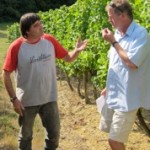 One thing I’ve learned at harvest time is that it’s all a matter of taste. At this time of year, we’re not talking about wine tasting, or blending, we’re talking about tasting and checking the grapes themselves. Every few mornings during the build-up to the harvest, we collect sample grapes in small plastic bags and hand them in to the lab, conveniently located at the end of our road, for a full analysis on sugar levels, acidity, PH and so on. We get the results by mid-afternoon. Sugars on the rise and acidity falling, hopefully. Technically, hit the right crossover point and one can get close – assuming nature marks the spot with a handily-placed X. Keep reading
10 Reasons why Bordeaux 2010 is not like 2009
August 27 2010
The weather’s been warm, sunny and very dry, giving rise to reports – there’s a summary of them here – of another magnificent vintage on the cards (don’t yawn). Anything can happen before the Merlot harvest begins towards the end of September, and in October for the Cabernets, but let me explain why 2010 is not like 2009.
It is, of course, too early to say how 2010 is going to turn out as September is such a critical month, but some things are so evident – and significant – in the vineyard, I thought I should point them out.
10 key points so far
Bauduc 2010: A Dry Old Party
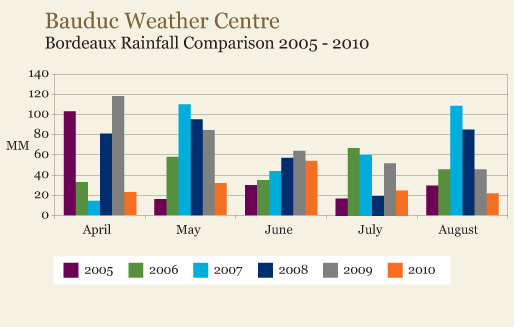
Too much rain in the Summer of 2007, frost in April 2008, hail (twice) in May 2009 and, yes, drought in 2010. “What next,” asked a friend, “rivers of blood?”
Welcome to viticulture, Bauduc-style, and 2010 will be remembered as the year of the drought. (Cue monsoons during the harvest.)
 We’ve seen half the normal rainfall in the five months since the beginning of April compared to the 30-year average in Bordeaux (see weather graphs in this article). Remarkably, the young vines have kept up with their older counterparts and look surprisingly healthy: with the lack of damp in the air, the risk of mildew has been reduced – unlike in humid Augusts like 2007 and 2008, for example – so most of the leaves look green and verdant with minimal spraying. But yellow leaves around the fruit zone tell a part of the story, as some of the vines have effectively shut down and the grapes have stopped ripening in certain parts of the vineyard.
 Of course, these problems resulting from the lack of rain are avoidable. Firstly, choosing to rip out crappy old vines and replacing them with young ones lead to this. Guilty as charged, but I’m glad to see the back of 3 metre-wide rows of Cabernet Sauvignon on vigorous rootstock (SO4 to be precise) pumping out bunches of grapes that never ripened properly and tasted of green peppers. I’m fond of our new Sauvignon Blanc (featured in all these photos taken today), planted on low-yielding rootstocks in 1.8m wide rows.
August Véraison: (Banned) Red Grapes Changing Colour
A couple of years ago I thought I’d plant some illegal grape varieties, under Appellation Contrôlée rules, in our Bordeaux ‘garden’. The photos were taken here at the very start of August and again three weeks later, before and after they changed colour – a stage called véraison. The Pinot Noir, which you’re more likely to see in Beaune, Oregon or Central Otago than Bordeaux, was well on its way in late July – much earlier than any of the other reds. Syrah is normally grown in the Rhône – notably the North – amongst many other places (it’s called Shiraz in Oz), while Grenache is found in the Southern Rhône and beyond (it’s known as Garnacha in Spain).
This has been all in the name of research, of course, and there is absolutely no suggestion that any of these terrible, alien grape varieties will turn up in our wine. However, they seem to be doing just fine, so perhaps I’ll have a good look at the ‘Vin de Pays’ or ‘Vin de Table’ option. Bordeaux Pinot, anyone? Watch out, DRC. Keep reading
August Véraison: (Permitted) Red Grapes Changing Colour
August 25 2010
Here are the six red grape varieties which we are allowed to grow in Bordeaux under Appellation Contrôlée laws. The photos were taken at Château Bauduc at the very start of August and again three weeks later, before and after they changed colour – a stage called véraison. A rule of thumb is that the grapes will be ready to pick some 45 days after mid-véraison. The third shot in each series shows the leaves of each variety, which for me is the easiest way to tell them apart (remembering what you’ve planted and where also helps).
Most of the 117,500 hectares of Bordeaux vineyards are red – 89% in fact. Merlot is the most widely grown variety, with 64% of red, and is the dominant grape on the Right Bank – St.Emilion, Pomerol, Fronsac and the Côtes – where it is often blended with Cabernet Franc (11%). Merlot is also responsible for the tanker loads of straight Bordeaux AC and less prestigious Appellations across the whole of Bordeaux. In other words, there’s Merlot… and then there’s Merlot.