


Category Archives: Ramblings and Rants
How technology is helping wine makers bypass supermarkets
June 26 2015
Victoria Moore, The Telegraph’s wine critic, wrote an interesting article on 20 June about European wine producers selling direct to UK consumers; naturally, we were delighted to be included – to be fair, there isn’t a long list to choose from – and to have our white described as ’beautifully crisp’.
’… Social media – together with simple email – is enabling small producers to form a more intimate relationship with those who enjoy drinking their wine.‘
Intimate? Steady on.

Anything but this
In fact, the piece was given the title How technology is helping wine sellers bypass the supermarkets, presumably by a sub-editor, with the introduction “Wine producers are using social media to sell bottles directly to their clients, with no middle-men required.”
Of course, ‘wine sellers’ are not usually the same people as ‘wine producers’, as Victoria explains:
‘Bypassing retailers and agents to sell direct is hardly a new phenomenon – I think every British wine drinker is born with an ancestral memory of stopping at a French roadside for a dégustation.
‘But modern communications technology is transforming the experience. Each of us is now like a miniature station, capable of broadcasting the minutiae of our lives across the world on multiple channels from Snapchat to Periscope to Instagram. This is enabling a joyful inversion of Amazon’s “long tail”; instead of one faceless retail giant amassing volume by selling tiny quantities of a large number of lines, social media – together with simple email – is enabling small producers to form a more intimate relationship with those who enjoy drinking their wine. Keep reading
In praise of big bottles and the rule of 5
May 20 2015
 I had the privilege of attending a smart dinner at Westminster Abbey on 18 May, at the start of the London Wine Fair. Chateau d’Issan from Margaux laid on a spectacular evening for many of the UK’s wine royalty, and I’d somehow sneaked an invite. The wines, from 1985, 1990, 2000 and 2005, showed just how brilliantly enormous bottles can age, and that when it comes to great Bordeaux vintages, the rule of 5 – those ending in 0 or 5 – is pretty reliable.
To be clear, ’the rule of 5’ arguably began in 1985 (1980 was a shocker), but has continued without doubt from 1990. My three personal favourites, for what it’s worth, are 1990, 2005 and 2010. The 2005s are only just coming round after a decade, and many need a few more years yet.
I think 2010, especially on the Left Bank, has the potential to be the greatest of the lot, but you’ll have to be patient for the great wines.
As for larger formats, I can’t think of a red Bordeaux that I’ve drunk from a magnum or larger that hasn’t been superior, or had more potential, than the same wine in a regular 75cl bottle. A large format with a bit of age can surpass a wine from a regular bottle – the difference between a wine that is delicious, as opposed to merely decent. Perhaps, also, it’s because you always drink a very big bottle with friends. Keep reading
Should you buy en primeur – or in bottle?
April 27 2015
 There’s been little incentive for consumers to buy Bordeaux en primeur in recent years, so can the chateaux turn that around with some ultra tasty prices? For the first time in four years, there’s genuine enthusiasm amongst the wine trade to get behind the 2014 en primeur campaign. “The market, though, is tepid” says James Miles, MD of Liv-ex.
There was a positive reaction to the wines at the annual Spring tastings here in Bordeaux just before Easter but, as most collectors know, there’s been no advantage in buying recent vintages while the wines were still in barrel. The 2011s, 2012s and 2013s failed to ignite much interest en primeur, so consumers are going to need some convincing; it’s now in the hands of the leading chateaux as they set their opening prices a year or so before the wines are bottled. For UK buyers, the exchange rate will help too.
Robert Parker, the world’s most influential critic, is no longer reviewing Bordeaux from barrel, but only in bottle, and this may affect the way people buy Bordeaux. However, if consumers don’t buy Bordeaux during the en primeur season, will they ever get around to buying once the wines are bottled? The golden goose could be in mortal danger.
There are umpteen 2014s that will be really enjoyable to drink. The question is, which should you buy, at what price, and when? Keep reading
UK Wine duty frozen
March 20 2015
’Frozen’ is a more dramatic way of saying that there was no further increase on wine duty in the Chancellor’s final Budget before the Election. There was a little drop for spirits, cider and beer. It’s the first time in many years that there’s been no rise, so we should be grateful for small mercies.
The chart also tracks the exchange rate between Sterling and the weakening Euro. So, with wine duty as it was and the pound strengthening, some good news for UK wine buyers.
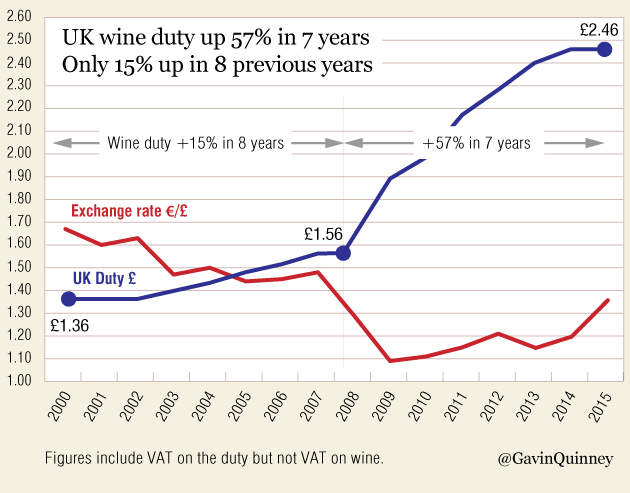
How the UK pays 67% of all wine duty in the EU
February 25 2015
We welcome the ’Drop the Duty’ campaign ahead of the 2015 Budget on 18 March. Tax on wine in the UK has gone up by 57% since 2008 but what makes wine duty so unfair is the amount you pay in Britain compared to the continent. Drop doesn’t mean ditch, in this instance, just ’reduce by 2% please, George’.
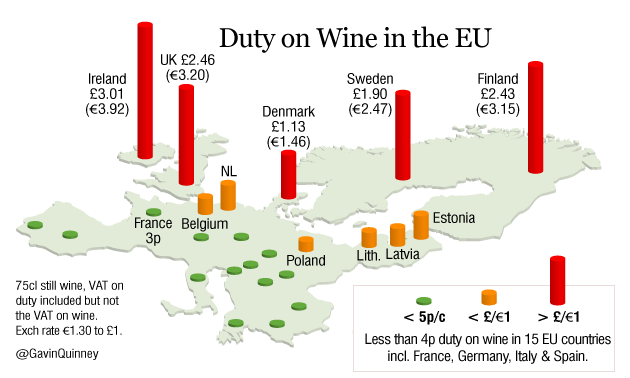
Source: ec.europa.eu, with current exchange rates. Malta has €1.77 wine duty.
With Britain having the second highest duty rate in Europe it’s little wonder, when you look at my duty map, that Britain pays two thirds of all wine duties levied across Europe, according to the The Wine and Spirit Trade Association, or WSTA. After all, there are 60 million people in the UK, compared to less than 24 million in Ireland, Sweden, Finland and Denmark combined.
A small but significant step
The WSTA is pressing for a small reduction of 2% off the fixed duty on wine, which is currently £2.05 plus VAT for still wine and £2.63 plus VAT for sparkling. The campaign invites consumers and the trade to write to their MP with an automatically generated letter, and signing up is easy. Keep reading
Bordeaux 2013 en primeur off and running
March 28 2014
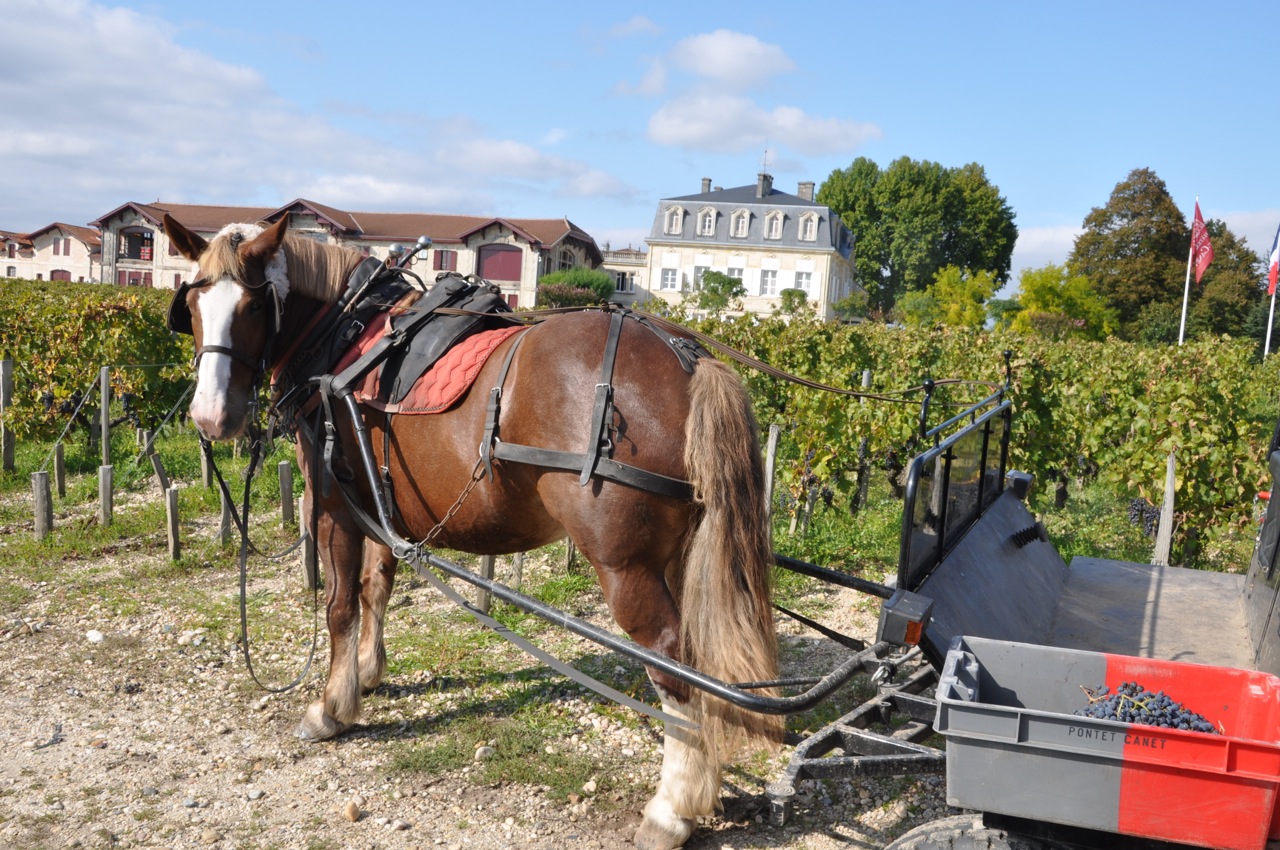 When Jancis Robinson asked me on Tuesday to write a piece setting the scene for the annual en primeur tastings next week, I don’t think anyone was expecting the first release of the campaign so soon.
Alfred Tesseron of Chateau Pontet Canet surprised more than a few people by releasing the price of his 2013 to the Bordeaux trade on Wednesday. It’s the first time a leading Chateau has put its wine on sale before the world’s wine merchants – and most critics – have had a chance to taste it.
Given that Pontet Canet (above right) has been on a hot streak of late, all the Bordeaux negociants I spoke to will be taking up the offer rather than risk losing future allocations. Most importers – who buy in turn from the negociants – are (quite rightly) saying that they’ll wait to try the wine first before committing themselves.
 ’It caught everyone by surprise’ said Charlie Sichel of Maison Sichel, who part-own Chateau Palmer (left). ’In view of the strength of the brand, and assuming the quality of the wine is approved by our customers when they come to taste next week, it might be quite clever. It’s a move that the entire Bordeaux trade will focus on; but there are very, very few Chateaux with such strong brand equity as Pontet Canet and any message to proprietors to release a small amount of wine at the same price is dangerous.’
Pontet Canet’s 2013 yields were ’lilliputien’ according to winemaker Jean-Michel Comme, about half the norm at 15hl/ha and a fraction of the 40hl/ha or so of the outstanding 2010 vintage. Allocations of the 2013 to negociants are therefore 50% down on last year. Keep reading
New Bauduc labels, new boxes
March 27 2014
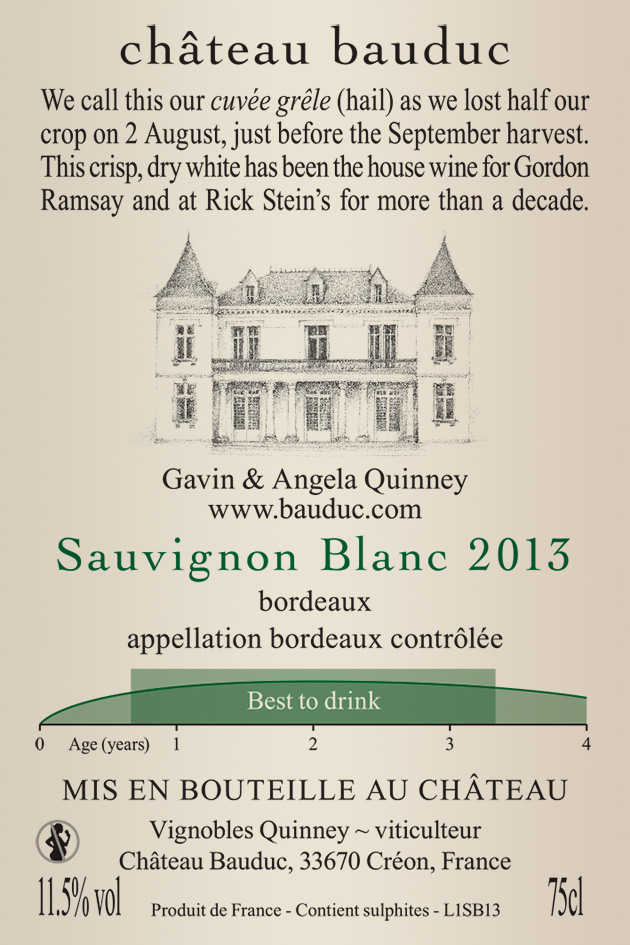 We’ve added a ’when to drink’ image to each back label and removed the QR code. If you’re wondering what a QR code is, that’s why we’ve ditched it. We have also taken on board what the lovely sommeliers at Rick Stein’s Seafood Restaurant observed when they changed ’Chateau Bauduc Bordeaux Blanc’ to ’Chateau Bauduc Sauvignon Blanc’ on the wine list.
Roni and Jason suggested that they change the title of our wine on the list, and sales have gone up fourfold. We also asked our friend Laura Clay, who hosts many Bordeaux tastings in the UK, to briefly survey the audience at one event. 58 out of 60 people said that they would be more likely to buy a wine called Sauvignon Blanc than Bordeaux Blanc.
Finally, having scanned the shelves of supermarkets in England at Christmas, there were an awful lot of cheap Bordeaux Blancs on offer. Of course, there are cheap Sauvignon Blancs too but it’s a popular grape; so we’ve decided to go with Chateau Bauduc Sauvignon Blanc.
Our old-vine Sémillon label, Les Trois Hectares, hasn’t changed. Keep reading
UK Budget – good and bad
March 26 2014
George Osborne scrapped the ghastly duty escalator on wine, which has seen UK duty increase 58% in 6 years to £2.46 a bottle. Hooray. The bad news for wine lovers (and, ahem, producers) is that wine was singled out for an inflation-linked increase, unlike spirits, cider and beer. Here’s my updated map, showing how the UK has the second highest duty on wine in Europe.
Ireland, look away now.

And here’s the updated graph showing the duty increase since 2000.

10 Takeaways from ProWein
 I just got back from ProWein, the massive wine trade fair in Dusseldorf, Germany. 48,000 visitors (up 7% from last year), 4,800 exhibitors from 48 countries. Here are ten things I learned about networking, wine and trade shows.
- The beauty of wine is that it has to come from a place. Unlike other industries, production can’t just be shifted to where the labour is cheapest.
- The price of wine is down to PEPS: Perceived Exclusivity, Publicity and Scarcity.
- If you think there are too many wines to choose from, you’re right. The number of labels is overwhelming. The trick is learning how to pick the right ones, or to know someone who can.
- If you own a vineyard, or are thinking of doing so, the show can make you feel like an existential drop in the vast ocean of wine.
- The number of visitors from China and Asia doubled from last year. China and Hong Kong combined, by the way, is the biggest market for Bordeaux, up from nowhere a few years ago.
- Prowein is popular with the UK wine trade. Buyers, journalists, merchants, sommeliers, brand owners and so on. Most of them are on Twitter.
- Pouring wine on a stand to random passers-by might be a good way to sell (or buy) wine if you like lucky dips. Arranging to meet existing and potential buyers/sellers seems more fruitful.
- A great lifestyle would be to have a European vineyard for April – October and another in South Africa for December to March. Overnight flight, similar time zone, good weather.
- The wine business is full of the most generous, interesting people from around the world. Even if we might all be broke.
- Next year’s Prowein runs from 15 to 17 March 2015. See you there. Twitter @GavinQuinney