Category Archives: Ramblings and Rants

Why the duty on wine in Britain and Ireland is unfair

WSTA-twitter-logoRight now there’s a welcome initiative in Britain called Call Time on Duty, organised by the Wine and Spirit Trade Association. The aim is to persuade George Osborne to scrap the automatic duty escalator in this year’s Budget on 19 March.

If I had to pick one reason why the level of duty on wine in the UK and Ireland is unfair, it is this:

004257_euro_duty_per_bottle-06

Source: data from ec.europa.eu, with update for Ireland. UK duty on sparkling wine is £3.07, including VAT on the duty but not on the wine.

Keep reading

2013 Bauduc white and rosé update

We’ve just blended our white and rosé from this tricky vintage. The August hailstorm at Bauduc wiped out half the grapes and we’ve been draconian with selecting only the best of the rest. The pale rosė is excellent but, for the white, we’ve only made 20% of what we hope to produce with our vines normalement*.

We’re happy with the amount of rosė – slightly more than last year, which is good news – and the quality is very good. Pale, crisp, dry, gluggable and refreshing.

Bauduc before after hailFor the white, we are allowed to make 1,100 hectolitres (110,000 litres) from 17 hectares. That’s a permitted yield of 65 hl per hectare (8600 bottles per hectare). I’m fairly confident that we would have made that had it not been for the hail.

As it is, we produced half that volume of wine and from this decimated amount, we have selected just 220 hl (29,000 bottles instead of a maximum 147,000) or 20% of the potential yield. This 20% was from vines that were hardly hit. The remaining wine we’ve produced (350 hl) is being sold off in bulk to Bordeaux wine merchants, who make blends for larger, non-chateau brands.

We don’t want to compromise the quality by including wine that was made with grapes that just didn’t ripen properly as a result of the vines being hit by the hail. I don’t think they ever recovered from the shock to the system, or that’s how it seemed, and with a much later harvest than normal, the grapes never really had a chance of being ripe enough. At harvest time, when tasting the grapes out in the vineyard, it was like biting into a cooking apple instead of a granny smith.

Onwards and upwards. Keep reading

Where the money goes on a bottle of wine in the UK

I put together a handsome graphic to illustrate what you get for your money with a bottle of wine in the UK in 2012, and the image has been referred to on Twitter and elsewhere regarding the recent (and most welcome) Call Time on Duty campaign.

Here is the updated picture to take into account the current duty and exchange rate. It makes for grim reading.

004245_bottles7

The calculations are taken from a spreadsheet compiled by Robert Joseph for his article Lifting the stone on the UK wine trade in The Joseph Report, August 2012. Robert is a respected industry commentator, the ’Editor at large’ of Wine Business Monthly and he’s one of the partners behind a French wine brand on sale in supermarkets and independent merchants. Keep reading

All go in the vineyard

Another year, another vintage. This will be our fifteenth full season at Bauduc and no doubt it will throw up some unforeseen challenges. Right now it’s pruning time, and whilst it’s not been quite as wet here as in parts of the UK, it’s fortunate that we’re up on a hill. Here are some Winter snaps.

The pruning started in December in ideal conditions: cold and dry with frosty mornings, so that the sap had fully receded; and there’s less risk of spreading some vine diseases if you prune when it’s dry.

Daniel and Nelly are pictured here, having to work their way around some hail-damaged branches. You can see where the vine shoots took a peppering from the hail in August. The damage was more severe on the ripening grapes than the branches, which wasn’t good news for 2013 but it bodes better for this year. Many of our neighbours were hit much harder and have real problems with pruning severely damaged vines for 2014.

Then it rained. Thankfully, most of the rain has drained off the slopes, although it’s pretty soggy on the clay plateau.

Keep reading

New Year, cheap wine and a letter to The Times

Times and Tesco - 05 - Version 2Inspired by a conversation on Twitter – see below – here’s my recent letter to the Editor of The Times.

I haven’t had a reply just yet, which is fine, but as I’m a paying subscriber, I hope he won’t object to me posting it on my blog.

“Sir,

Jane MacQuitty recommended two French wines for New Year’s Eve parties in ’This week’s best buys’ on 28 December. The retail price of the white is just £3.75 and the red a few pence more.

Given that 70% is tax (£2 a bottle UK duty, plus 20% VAT), I was intrigued to see what you get for £1.12 for the wine, the bottle, packaging, the ferrying about and retailer’s profit.

I wanted to like them, really I did. There is a place for the cheapest supermarket wines but it’s hard to imagine how any Times reader, with even the vaguest interest in wine, enjoyed these two bottles on New Year’s Eve.

January seems a good time to drink less and put the savings towards bottles which cost £5 or more, after discount. A handy guide is that £6 is the price above which the product itself accounts for more than the tax (£6 = £3 wine and margin, £2 UK duty, £1 VAT).

Come on, Jane, let’s raise the bar in 2014 – just a little. Keep reading

Bordeaux 2013 – Parker delays primeurs verdict

DSC_0745 - Version 2The American wine critic Robert Parker will not be publishing his report on Bordeaux 2013 until the end of June 2014, two months later than usual.

Lisa Perrotti-Brown MW, editor in chief for Parker’s Wine Advocate and erobertparker.com, confirmed that ’Bob will be doing his tastings slightly later this year’ and will publish his notes in the summer.

The release of Parker’s scores at the end of April is traditionally the focal point of the en primeur campaign. He normally comes to Bordeaux in March to taste the barrel samples provided by the châteaux, and his ratings can have a significant impact on the price that the wines are sold for in the second quarter of the year. The en primeur campaign – the sale of wines as ’futures’, a year or so before bottling – is usually wrapped up before the summer break.

The last time Parker did not attend the primeurs tasting season was in spring 2003 when he eschewed tasting the embryonic 2002 vintage due to concerns over the Gulf War. The 2002 First Growths were released at a knock-down consumer price of £60 a bottle.

Meanwhile, in Bordeaux, many producers are increasingly enthusiastic about their reds after the most difficult growing season in years (’here we go again’, I hear you say).

Christian Seely, managing director of Axa’s estates, has eloquently written about his ’moments of intense relief’ when tasting the wines at Châteaux Pichon Baron and Petit Village for the first time. Read more about the ’joyous triumph over adversity’ on his blog. ’But don’t just take my word for it. Come and taste them. I think you will be agreeably surprised’, he writes. Keep reading

‘Global wine shortage’ and what the UK pays – part 2

Bottles washed, dried then filledAs a follow-up to ‘Global wine shortage’ and what the UK pays – part 1, here are a few thoughts about the likely impact on UK consumers.

Supply and demand

  • A balance between global supply and demand would be welcome. The biggest threat to many good wine growers’ financial stability is that there’s too much wine on the market.
  • Over or under supply has to be viewed region-by-region. In Bordeaux, we’re about to see the impact of a small, generally inferior crop in 2013. In the bulk wine market – we’re talking a euro a litre – stocks of 2011 and 2012 (the best of the three) will be swallowed up.
  • Elsewhere, as Dan Jago, Director of wines, beers and spirits at Tesco, puts it, ‘there’s a lot of wine around that doesn’t have a home to go to.’

The UK and the rise of ‘Own label’

  • It’s fair to say, on this evidence, that UK supermarkets and major retailers are expert at extracting the best price – after all, the UK is a hugely competitive market.
  • The average UK retail price of just over £5 contains mostly tax (£2.84). At a fixed £2 per bottle duty, plus 20% VAT on the wine and the duty, a £6 bottle contains £3 of tax. That leaves £3 for the wine, packaging, shipping, distribution and margins.
  • I think there’ll be an even stronger move towards ‘own label’ brands in the UK, away from the unsustainable fakery of ‘half-price’ offers on brands.
  • The UK sells more ‘own label’ brands than elsewhere: 50% of retail brands sold in the UK are ‘own label’, compared to just 5% in the US.
  • Tesco’s Finest wine range has risen to 139 lines, Marks & Spencer’s wines are almost all ‘own label’, the inexpensive Aldi Exquisite range has been quite well received, and so on. As ‘own label’ wines are attractively priced and discounted less, that has to be welcome. Consumers know where they stand – brand wise, price wise, quality wise.
  • ‘Own label’ brands are used not just by supermarkets and retailers but also by agents and importers for the UK restaurant, bar and pub trade.
  • Champagne and ‘fine wine’ apart, you’re increasingly unlikely to see the same label from a supermarket or major online retailer in a bar or restaurant. Unlike in Spain, for example, where you know where you are with brands that span both on and off-premise.
  • So don’t feel embarrassed if you don’t recognise the wines labels on a restaurant or pub wine list. You’re not supposed to, and even wine experts can be clueless on this one. Keep reading

‘Global wine shortage’ and what the UK pays – part 1

Wine VisionLast week, I presented at a global wine conference in London, called Wine Vision. One presentation was on the ‘trials and tribulations of selling direct’, the other on digital communications, as part of a panel.

There were a few things to be gleaned from the event, other than the obvious networking thing (and, my word, there are some brilliant people in the wine trade):

One, if you want to fill a room, talk about how digital and social media can work for business. Two, that the US and China are the growing markets for wine.

Which brings me onto the news story about the global wine shortage. We’ve had numerous messages from friends who are concerned that wine is about to run out. Don’t worry, it isn’t, but there are some interesting points to come out of the detailed report by Morgan Stanley Research.

You can download the 77-page, 1.3mb pdf here. It reads like a massive Infographic.

The report made the mainstream news because of some fairly startling observations about a ’global shortfall’. Here’s the executive summary (page 3):

  • ‘Global wine production peaked in 2004 and continues to decline. In 2012, production declined to its lowest level in 40+ years. Global consumption inflected (?) in 2010 and continued growing in 2011 and 2012.’
  • ‘Global under-supply is at its deepest level in more than 40 years. Data suggests there may be insufficient supply to meet demand in coming years, as current vintages are released.’
  • ‘In the past couple of years, production declines have continued in France, Spain and Italy and new world production has peaked.’
  • ‘The French remain the largest consumers of wine, with consumption maintaining a positive trend since 2010, following decades of decline. The US is now a very close second.’
  • ‘The US and China are the main drivers of consumption growth globally.’

My experience of late, both here in Bordeaux and at the event in London, certainly supports that last point. (China came from nowhere to become the largest export market for Bordeaux in only five years.) Keep reading

Bauduc ‘Hail Sale’ in The Telegraph

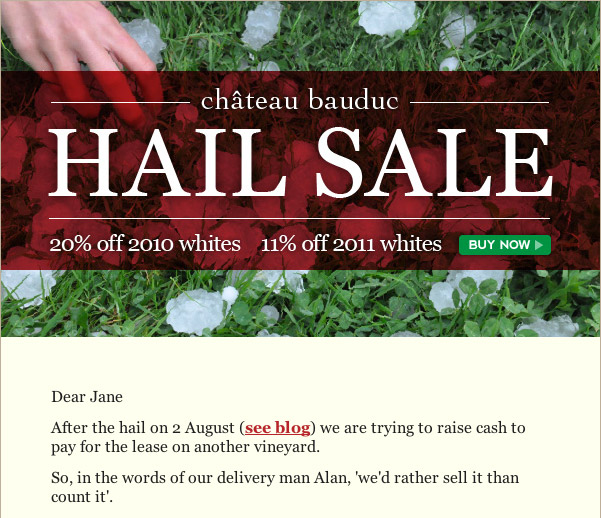
hail_saleMany thanks to everyone who chipped in for the Bauduc hail sale. The offer on our 2010 and 2011 whites went down really well and prices are still at a knockdown rate, so do stock up before the Christmas rush; if it’s been on your to-do list, please take a minute to order.

It was great to see the ‘hail sale’ in the Telegraph wine column at the weekend. In her article on buying online, Victoria Moore perfectly summed up what we’re all about, after mentioning Tesco, Morrisons, Asda, Laithwaites and The Wine Society.

‘But for me the real thrill of online wine shopping is the chance to escape the giants. It’s all about stories, immediacy, connection, a chance to root around making new discoveries or, more to the point, getting in touch with people who’ve made them for you, buying the wine you want when you want and having it delivered all with sublime ease.*

One online micro-trend gathering momentum is for producers to sell direct to customers. Think of the likes of Gavin Quinney, whom I wrote about over the summer when swathes of his crop were smashed by bad weather, and who is now having a “hail sale” (Bauduc) to try to get back on his feet.’

Back in August, we emailed everyone with a link to Victoria’s article ’Hailstorms: when ice and wine don’t mix’. A dramatic piece about our little catastrophe was probably not the ideal press coverage but it was a welcome silver lining:


Keep reading

What people say about Bauduc on Twitter

IMG_9051Here are a few things that people have been saying on Twitter about Château Bauduc.

Twitter’s new custom timeline feature is a nifty way of bringing together a few choice tweets on any subject. (Here’s a brief guide and a video on how to create a custom timeline using Twitter’s Tweetdeck, which is how timelines have to be created. I recommend Tweetdeck if you run two or more Twitter accounts; mine are @GavinQuinney and @ChateauBauduc, while @BauducAnge spends most of her time following cricket.)

Scroll up and down inside the box to see the brief selection of tweets. We’ll be updating the timeline, so you’ll see more recent tweets than the date of this blog post. Thank you to everyone who has tweeted… and keep tweeting.

Here’s what it looks like on Twitter. If you have any questions, do ask in the comments box below, or send us a tweet.

Twitter grew 44% from June 2012 to March 2013, according to a survey.